Sunday, July 2, 2023

VA Shenandoah National Park: Upper Pocossin and Dean Mountain

 On a hazy, Canada fire smoke-filled day in Shenandoah National Park, we decided to go exploring down a nearly hidden fire road off Skyline Drive to visit the ruins of the Far Pocosan/Upper Pocossin mountain community and mission. Like so many dozens of other mountain communities, this village crossroads and surrounding hill farms were cleared to make way for the new park in the 1930s.  As many of our hikes in to the park have revealed over the years, the story is a similar one of displacement, resettlement, and return to nature.


Remains of the mission worker's house

As we walked along we encountered a bear-scrounged tree missing its yummy ants and cronchy beetles. We were happily surprised by the calls of Blackburnian and Hooded Warblers and escorted almost the whole way down the holler by Eastern Wood Peewee and Goldfinches. The road under our feet slipped from pavement to cobbles to dirt to wagon ruts to single-wide trail. 


Mission workers house next to the stone chapel at Upper Pocossin Mission.
Source: Larry E. Lamb Collection (BRHP) 


At the crossroads, we explored for an hour or so, poking in and out of cellar holes, peering into the precariously leaning remains of the mission house, probing stone foundations and the remaining stone steps. I don't know why we didn't go further down the road towards the South River - there are more ruins and foundations, including a cemetery closer to the river. Instead we lingered for long in one place. I can't speak for my sister, but I found myself lost in imagination, trying to reanimate the place in my mind. Could I hear hymns being sung in the church or children reading aloud to their teachers in the school? Or did I hear someone yell a warning to folks further down the holler that a revenue man was making his way over from Dean Mountain?


Tall Thimbleweed, Anemone virginiana

In this place,  a bridle path and trail intersection are all that remain of the busy mountain crossroad. I tried to imagine the general store and post office, and in the 1920s, a filling station (built in anticipation of increased vehicular traffic as the national park was established). The people who lived here had an intimate knowledge of the land as farms, orchards, and wild edges that climbed the mountain to its ridge.  To outsiders like those mission folk, the mountain community here was isolated, superstitous, marginal, and in need of a modern God. 


Amos on the steps of the Upper Pocossin Mission Church

A builder of churches, Minister Frederick Neve answered the call to build Epsicopal missions clear up the spine of the Blue Ridge Mountains across seven Virginia counties. He arrived in Virginia from England in 1888 and served as rector of Emmanuel Church in Greenwood, Virginia, until the mission bug bit - and bit hard.  Receiving permissions from the regional bishop, Neve set out to site, build, and staff a dozen new mission churches and schools to serve mountain communities.  With each site, he included the main church or chapel, mission worker's home, and a school or community hall that doubled as school and meeting.


Left front facing corner of the church. 


"After the work [in the Ragged Mountains] had been carried on for some time, I could not help thinking what a good thing it would be if the same kind of work could be extended to the Blue Ridge, where I knew from what I had heard, the conditions were very similar to those prevailing in the Ragged Mountains, only worse...my idea was to plant strong missions all along the Blue Ridge, about 10 miles apart." - Frederick Neve, 1902


Black bear scavaged tree

Of course the communities that Neve selected for "saving" didn't all want to be saved. In fact, many resisted his efforts and in the case of Upper Pocossin, violently so.  The community liked its isolation and that, for them, could be interpreted as a kind of depth of place felt by people having for so long been left alone.  But the Episcopal Church prevailed and the mission was built and the young, good virtuous women of God, sent to serve as school teachers kept diaries and wrote letters home. They painted a picture of both pity and reverence for these people, being not at all what they had expected, and with whom they found a firece sense of independence and spirit. 


Missy Breeden, at her home in Upper Pocossin Mission. She was given 
lifetime tenure of her home by the NPS and died in her beloved
cabin in 1949.  Source: NPS Archives


The intersection of trails that wraps around the ruins once carried horse and wagon, buggies, and mostly people walking up and down the mountain. Before the mission, the most engagement these folks had with the federal government would have been the post office. A young mission worker wrote home that while the community folks were interested in what was happening in the outside, they were content not to have the government or wars or extractive industries intrude upon their world.  Over time, the community came to accept the young mission workers and their church. No one could have imagined then the impact the new park would have had on this and dozens of crossroad communities throughout the Blue Ridge in the coming decade.


The abandoned stone and timber built Episcopal church,
Upper Pocossin Mission, 1940s.
Source: Larry E. Lamb Collection


We hiked back up the old road to the Skyline Drive and the hidden dirt lot where we'd left the borrowed truck. (I hope I can get my truck back soon!) Then we drove to another hidden road and found the Dean Cemetery, still in use and very well cared for. Again, we lingered here. The Dean Mountain community thrived on the western flank of the ridge, opposite the Upper Pocossin community.  Reading the log book for comments left by relatives and visitors was really cool. 


Dean Cemetery


The system of mountain roads that once tied these far-flung communities together are now designated as fire roads and can be explored with thr right maps. Not all are marked today as trails in the park literature, so many are overlooked by hikers. It made us more curious about finding and following these old roads, though there are many folks who have made it their outdoor passion to do this and several folks have written books or maintain YT or blogs about these adventures. 


Artifact from the Dean Mountain community


Later, at home, I consulted the NPS historic tract map to see which families owned which tracts at the time of the park buy-outs (or in some cases, aquisition by eminent domain). Many of the names we read on stones in the Dean Cemetery were also names from Upper Pocossin: Meadows, Greene, Dean, etc. These communities married into each other and maintained ownership of vast sections of mountain properties as farms, timber land, and orchards. The roads that connected them, as well as some of the existing trails, were walked or ridden by these people to visit, attend meetings, burials, church, and weddings for two hundred years. 


Pocossin Road  


These paths as fire roads or trails today, were the connective strands of a web of communications and thriving mountain society a hundred and more years ago. The idea of isolation and marginal existence was misapplied to these communities by outsiders then and enhanced by the take-back-by-nature appearance of these places today. Though I love the wilderness that is the park today, the road system and trails have taken on new meaning for me as I look forward to more fire road rambles to come.


Toppled stove chimney of the Pocossin Mission church.


Far Pocosan, Night or Day

Reverend Frederick W. Neve


Knight ushers in the Brighter Day

And yet she does not pass away; 

For strange to say

She shines and drives dark away.

Since this is so, it must be right

To call her Day, as well as Knight. 


AllTrails Map of the Pocosin Road (now Pocosin Trail) and Dean Mountain


Notes:

Ben Swenson's excellent blog Abandoned Country is a great source of information about these disappeared places that nature is now reclaiming. https://www.abandonedcountry.com/2013/01/07/far-pocosan-wild-with-moonshine-whiskey/
 
Blue Ridge Heritage Project is dedicated to raising awareness and educating SNP/Blue Ridge Country visitors about the displaced people of the Blue Ridge during the 1930s-40s. 

NPS Tract Finder Map is a useful tool for finding the old road systems (now demarcated as fire roads) and the family names of last owners. 

Saturday, June 24, 2023

Sister's Campout 2023: Changing it Up

The day before I leave for the southern district of Shenandoah National Park to join my sister Laura for our annual sister's campout week, I made the decision to outfit a borrowed truck for the week while my own truck has been sitting idle at a repair facility with a thrown piston rod awaiting a new engine. It's been a very expensive summer so far. One I can hardly afford. But my son, a conservation photographer who is off on his own adventure north of the Arctic Circle, has gracioulsy let me borrow his Toyota Tundra so I can make this trip. Changes to how I do things. Changes to what I can take. But I am incredibly thankful. 


Clearly  not my truck

With less that 24 hours before I go, I build a tent and gear deck for the Tundra then, as if on cue the mailman shows up with the new truck tent I ordered two days ago. Granville, a gear, truck, and tool company from Canada has supplied me before with very decent equipment - but only when I've been in Canada at a bricks and mortar store. (Looking at you PEI, NB, NS, ONT) This is the first time I've puchased a Granville product online while not in Canada. Affter some initial fooling around with assembling and positioning, the tent is set up and I decide this might work! The real test will be this week in the Appalachians with the daily storms and rain showers. 


Trying on the new truck tent

I went to the dealership to retrieve my gear so I could repack it to fit the new ride. A parts department person came out to ask me what I was doing and I told her about how my own truck is my "road home" and that I basically have to move everything to the Toyota to make this upcoming camping trip work. "You don't have much stuff. Do you take a bunch more from home?" I tell her no. I camp in my truck shell and everything I use to stay weeks on the road (besides food) fits in and under the built in bunk. She looks incredulous. "Geeze," she says. "We have a 40-foot RV and we still tow a utility trailer behind it because we have so much stuff."  I can't even imagine.


Missing my ride

When I built my F-150 out a few years ago, I remember deciding how much stuff I really wanted or needed for a comfortable two week to month long camping trip.  It wasn't hard to scale everything down to four categories: kitchen/pantry, clothes, sleep system, gear. From there it was a bit like backpacking, considering essentials and what I wanted to provide for both Amos and I. But when it came time to reorganize and repack to fit my son's truck, I took another look and decided I could do with another round of slimming down. It wasn't hard, save for making room for the new truck tent.


Goodnight, Susquehanna

After all was sorted and packed, Amos and I took one last stroll down to the river. This time tomorrow we'll be snug in the truck tent in Shenandoah National Park. On the river the rains, for now, have ended and a river-blue sky soothes retreating storm clouds into the twilight.  It's been too long since I've had a break. Too long since I've taken a long hike or sat on a summit in awe of those ancient mountains.  A  lot has changed in a year's time. A lot of changes were made today. And, it's time to think about making some more changes in the months ahead.  I've made a few serious commitments in the last year. And, I've unmade some, too.  All in an ongoing attempt to lighten the load and experience the solace of a different trail. 


May we not neglect the silence
printed in the center of our being.
It will not fail us.

~Thomas Merton


Friday, June 2, 2023

PA Memorial Day Ride: Enola Low Grade Rail Trail

 Enola Low Grade Rail Trail: Red Hill to Turkey Hill, Out & Back 20 miles

My "backyard rail-trail" the Enola Low Grade is only minutes from my  home across the river and thus I am biased when I say that it may be one of the best rail trails in the region. Gloating aside, I took my first-of-the-year bike ride on Memorial Day morning in May which is probably the latest start I've ever had to my biking season. Sounds like a good reason to extend my winter riding to make up for lost miles and days this spring.


The deck is decked out on the Safe Harbor Trestle

Like banners and flags put out for the holiday, there are symbols of late spring and the start of summer all along the trail, but you have to stop now and then to find and enjoy them. I took four walking breaks over twenty miles just to look for nature's sign that summer is upon us. Eagles were everywhere, of course, as were Osprey and Great Blue Herons. The frequent release sirens from the Safe Harbor Dam drew birds up and down river to the bubbling waters in expectation of fish. 


Human and avian fishers were hanging close to the dam

Mountain Laurel near the Turkey Hil Trailhead

Wild Carrot in the brushy edges

Greybeard and Mustard near Shenks Ferry Wildflower Preserve 

Tulip Poplar blossom 

By the time I'd reached the Turkey Hill trailhead I noticed a huge increase in visitors to the trail. People walking, jogging, biking, birding, railroad history buffs, sight-seers, and many Mennonite and Amish families pulling picnic coolers on wagons crowded the trail. My friend John was out on his e-bike helping people spot eagles and landmarks on the river. I just missed the only snake of the day as a father and daughter backpacking the entire trail for the weekend (35 miles) had only then just assisted a beautiful Milk Snake into the woods out of harm's way. "It was gorgeous!" said the twelve-year old hiker, carrying full kit for the first time but looking very proud of herself for the effort.


What happened here?


A family of ten occupied an entire picnic table near a bent and braced overhead tower beam and were roaring with laughter as each came up with a silly tale for "What Happened Here?"  The eldest son took home the prize with his hilarious tale of a giant ox racing an engine and crashing into the beam when he turned to look back at the engine behind him. Clearly this maneuver cost the ox the race! 


Highview, Round Top, Wrightsville Bridge line up behind the Conejohela Flats islands

Pequea Creek from Martoic Trestle


Mid-morning the tempertaures were rising along with the number of people on the trail. I biked east over the Martic Trestle where the crowds were smaller but the dust was up. My face and legs were covered in the limestone dust that rose in swirls behind every rider. At my end point, also my starting point, at Red Hill Road everything was caked in white stonedust, me and my bike!


Notes:

Susquehanna Greenway Partnership on the Enola Low Grade Trail


Tuesday, May 9, 2023

PA Welsh Mountain Nature Preserve: Second Spring

The season of spring ephemerals is ending as the forest canopy overhead fills in. The forest floor, now dappled with filtered sunlight, is becoming shady and cooler. I'm scouting trails for a new phenology program and making note of the next phase of the spring guild of wildflowers, a second spring.


In this maturing oak forest, the quality of light is crucial for orchids which desire an ethereal, almost delicate blend of sun and shade. The whole forest floor is in motion with shadows of the early canopy dancing across banks of Mountain Laurel and Pink Azalea and for a time I am distracted by it and almost miss my first Whorled Pogonia of the afternoon. 


Whorled Pogonia, Isotria verticillata

It is sitting in the brightest shade nearest the trail and in full bloom with a small white lipped flower caged by three dark purple sepals. The flower seems to emit its own magical light, blinking on and off again as sunlight shifts across the forest duff. I know this plant will not be blooming when the summer hiking program begins - its bloom is as fleeting as the filtered light of the emerging canopy overhead. By late spring, then in deep shade, it cannot be found. 


Pink Lady Slipper, Cypripedium acaule


In a certain way, I love this stage of spring more than the early ephemeral season, as it requires the slow walk and steady search. Nothing is obvious. It requires something of you, some skin in the game, an investment in time and patience. The Pink Lady Slippers are everywhere but I need to adjust how I look into the woods to see them, despite  being one of the largest native orchids found in Pennsylvania. I see more when I hunker down and eye the forest from below crooked trunks of Mountain Laurel. 


Bracken Fern


I note both orchids in  my sketchbook, adding date, locations, and time of day, as these are important finds for tracking the changes in natural history of this successional oak forest. I'm thinking this trail may serve as an excellent phenology path and add those notes to my sketchbook, too. I'm excited to launch our new phenology program next year and make a few notes about that, adding another layer of distraction when all of a sudden an Ovenbird lands near by and startles me back into the moment. Wow! What a loud bird! 


Mountain Laurel

The Ovenbird continues to holler across the mountain - I'm sure they can hear him in Lancaster ten miles away. I wade through a bright thicket of Mountain Laurel, its old leaves spotted and brown with age, ready to drop as the new leaflets shoot up in bright green flames unfurling. Some might think the laurel is sick but it is a very healthy evergreen, preparing to shed the old foliage.


Indian cucumber root, Medeola virginiana


Canada Mayflower, Maianthemum canadense


Wild Pink Azalea, Rhododendron periclymenoides


Everywhere are the Wild Pink Azaleas, or Pinxster Flowers to some. Their delicate pink hues are lost in the sun dappled green and tans of the forest floor but once I see one, I see hundreds. The blossoms are showy and airy, delicate stamens shooting far beyond the flower. Like many of the spring guild of wildflowers, this show won't last long.  Despite its fragile appearance, this plant thrives on disturbance and is quick to occupy a sunny opening in the canopy when a tree falls. In fact, most of the groups I observed were crowded into pools of sunlight. 


That said, this wild azalea does not compete well with invasive non-natives that can quickly overtake their habitat. Privet and bush honeysuckle are serious threats as they leaf out earlier than most shrubs, shading and crowding out native shrubs that are waiting for the perfect sun-shade conditions later in spring. My childhood woodlands of Wild Azalea under towering Red Oaks completely disappeared in five years under invasive pressures of bush honeysuckle. Privet and bush honeysuckle are good examples of ecological stressors that impede or compromise native wildflower progression during bloom periods.  Unchecked, an entire ecosystem can be affected, weakened, and disappear. 


Common Brown Cup Fungus, Peziza phyllogena


Almost invisible to the hurried hiker are the rafts of fungal structures emerging along the path. Edible varieties like the Brown Cups and Oyster Mushrooms are popping up in mixed hardwood forests, and gatherers who know their timing will note that Brown Cups appear a week or so before their favorite Yellow and Black Morels. I talked with a fellow turkey hunter at a recent event to hear him describe a group of gatherers who walked right up to his sit-spot in the woods to ask him whether he'd seen of their favorite mushroom. He wasn't happy about that, but did tell them it's too early. "The Brown Cups are just appearing - come back AFTER turkey season!" 


The special light of second spring


Notes:   We're starting a phenology group at Lancaster Conservancy and if you are local to York or Lancaster County, PA, watch for the start of this great long-term community-based conservation science project in winter of 2023-24! 

Check it out:    Nature's Notebook/ USA National Phenology Network https://www.usanpn.org/natures_notebook


Tuesday, April 11, 2023

NJ: Bass River and Wharton State Forests, Pine Barrens

Camping for Easter weekend with two teens in the New Jersey Pine Barrens held special significance for us as we continue to work through the loss of a beloved family member back in September. As we tick off first holidays without their Poppy, the kids seemed excited to find new ways to think about loss. Spending time in nature can certainly help.  On our Easter campout, it seemed fitting to reflect on themes of death and resurrection, loss and rebirth, while hiking through last year's big burn area in Wharton State Forest. 


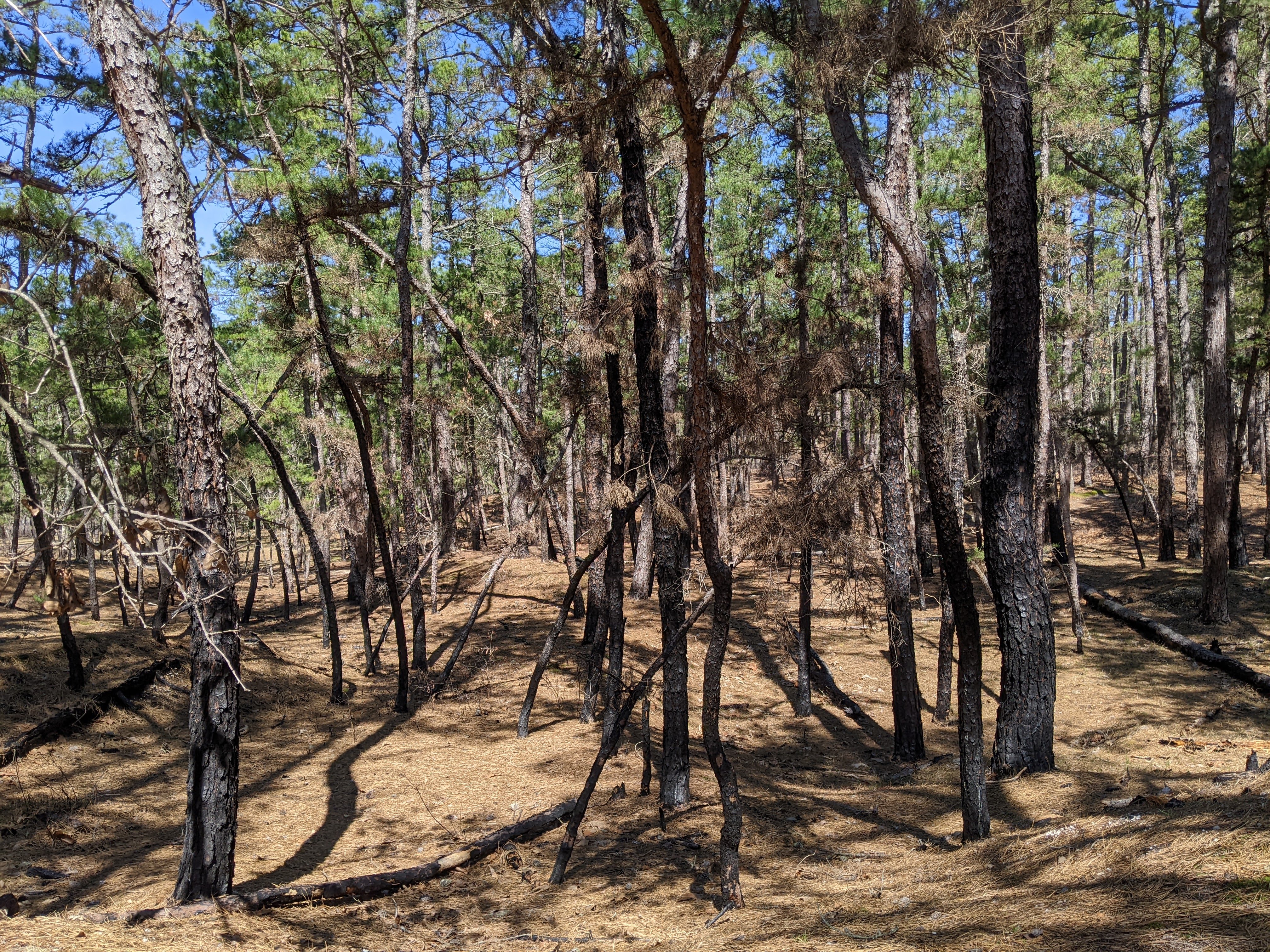
Last year's wildfire season was already in full swing when in June, 2022, Father's Day Weekend, an illegal campfire - unattended and whipped up by afternoon winds - caused the  biggest blaze in 15 years, the 17th largest since fire history of the Pinelands has been kept. It spread across portions of several townships, through the Wharton State Forest, and along the Mullica River. Backpackers and campers were evacuated from the Batona Trails, surrounding recreation areas, and backcountry campsites. The fire cost nearly one million dollars to fight. Certainly not a prescribed burn, these are the kinds of fires the Pinelands see more of as fire season expands to nearly year-round. 


                                        . 


We walked through a blackened forest carpeted in thick layers of crispy needles of Pitch Pine, yet everywhere - on charred trunks and from the ground - sprung fresh needles of saplings and shoots. The teens, never having witnessed a recent burn like this, were speechless as, mile after mile, it seemed a new forest was emerging from the old. Pine cones lay open, some eaten by squirrels, others having lost their seeds to the forest char and duff. Pitch Pines are fire dependent and this is just what those closed up cones needed to force their opening. But we were aware of the intensity of this fire that nearly captured the crown and spread so fast that people just escaped with their lives. 


Up from the duff and ashes sprang Low Bush and High Bush blueberries alongside fresh green shoots of Sheep Laurel and Leatherleaf. We gawked and giggled past impossibly green mats of new Bearberry with their blossoms of pink and white tended to by Bumble Bees and Miner Bees. We watched ground nesting Miner Bees emerging and returning to exposed sand beds. "Whoa!!" they laughed as a parade of tiny bees flew in and out of a hundred sand tunnel entrances. 


Sand myrtle, Kalmia buxifolium


Trailing arbutus, Epigaea repens


Leatherleaf, Chamaedaphne calyculata


The trail turned towards the Mullica River and soon we saw an Osprey, another Rite of Spring. (Thank you, Rachel)  Every log was crowded with Eastern Painted Turtles and a big American Snapper hung motionless with her mossy green shell just breaking the water, her head and snout pointed at us, looking. A Yellow Warbler flitted from the branches of a White Cedar while a flock of Pine Warblers chatted it up in the tops of the highest pines. Even with the black ash and charred trees all around us, spring seemed unusually colorful and surprisingly joyful in the pines. How could we not giggle? 


An unburnt section near the river


Admiring the Mullica and its many turtles


In the Pine Barrens 

The pines here are incendiaries: not
      content to wait for conflagration,

they brim themselves with pitch,
        living torches spoiling to be lit, 

dry needles kindling on the sandy soil,
        cones hard, uncrackable except

by fire, seeds dormant till released by flames,
        to fall unchallenged on the flame-cleared

ground. The trees don’t mind being scorched,
        as long as the barrens can be swiftly

re-sown by their progeny, hardy, reckless, fully
        as combustible as themselves.


From the collection Nine-Bend Bridge (2018)
Winifred Hughes


Sand road (and fire break)


Fireproof Pitch Pine


New forest beneath the old, Pitch Pine, Pinus rigida


We found a patch of freshly emerged Bayberry and picked one leaf to crush and breathe in its intoxicating scent, an important medicinal plant for Lenni Lenape and pinewoods doctors like James Sill, brother of Underground Railroad Founder, William Sill. I found a remedy of Dr. Sill's, who described the oils of Bayberry as a curative for sore feet and legs, "when bathed in warm water with ashes added to aid in circulation. It has an astonishing effect."  Off they went, almost at a jog to finish our hike, revived by the Bayberry and the promise of a food truck at Batsto Village that offered real Italian ice. 


Northern Bayberry, Morella pennsyvanicus

Notes: 

James Sill ( 1877) Early Recollections and Life of Dr. James Still. Forgotten Books, Middletown, Delaware. 


Tuesday, March 7, 2023

Emergence: An Apology

 I wanted to apologize to all the readers of my blog for my disappearance and lack of posting anything at all about the natural and unnatural, even supernatural, encounters with Mid-Atlantic environments. I've been overwhelmed with life, and while the holidays hit particularly hard this year, I stopped writing, exploring, and researching pretty much since then. 


I tried to retire but I failed spectacularly at it. I discovered I am not built to navigate the retired life successfully but I did not want to go back to the crazy-making life of toxic work culture. I discovered that being bored is just as toxic. Not even long walks in the woods helped. 


Still processing the loss of beloved family members, and the immensity of the empty spaces they leave behind, I took time to think and pray and remember. Months of  time. The loss of my spiritual director, a beloved elder Franciscan contemplative from the mountains of central PA, made the emptiness profoundly unbearable. I took on a new full time job. I went back to teaching as well. 


All this to say that I just couldn't throw things into this blog for the sake of having it take up content space. It was best to give it a rest, too. Mid-Atlantic "nature" is complex and rooted deeply in our history. It needs to be experienced in a way that calls for our presence and reflection and honest assessment of what is natural and what is not and why it matters. 


My sister and I recently talked about ancestors and memory and why someday we may move back to the mountains that contain our childhoods and family stories and all the familiar places that raised generations of Scots-Irish immigrants and their offspring. I have distinct memories of those people who raised me and even of ancestors I never met but who were important in how we related to our environment and each other. Lots to contemplate when faced, too, with the loss of landscapes forever changed by "progress" or climate change or neglect or ignorance. 


I wasn't surprised the other day to find that I was fly-casting next to a Franciscan brother, up from seminary to enjoy some outdoor time. Who better to fly fish with than a monk?  I asked him about sorrow and nature and whether he was using nymphs or flies. It was just conversation I needed and it  made me remember readers who have been in the dark about what happened to me. Brother Mike said that we all need time in the dark, nymph-like, to contemplate our emergence. We were both using nymphs. 
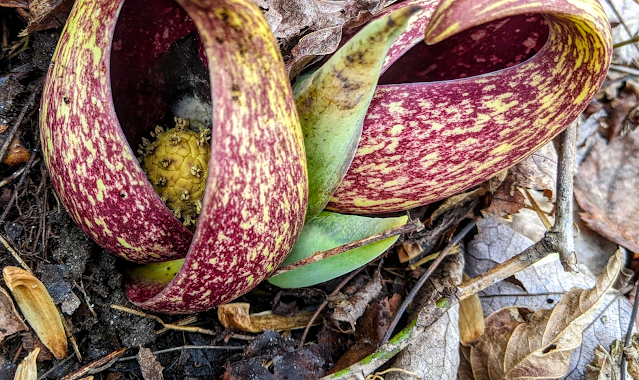


So that's it. My list of excuses and reasons not to have gotten out in this winter of no winter. Thanks for understanding that my absence here is by no means an abandonment but a reconsideration of the purposes of this blog and the time and care it takes to keep it going. Maybe a book would be better? Maybe some essays or poems? An academic paper? We'll see. I'll keep you posted.