The New Jersey Pine Barrens can be a magical place for a young hiker to explore - minus the heat and bugs - so that's exactly what my grandchild Kenzey wanted to do on her Friday off from school. This was her first experience of the pine barrens and with a cold Atlantic wind blowing, it was mostly people free as well, with the whole day devoted to listening to the forest. She hiked along in complete silence, stopping now and then to stand and listen. "Where does the sound go?"
 |
| Pitch Pine in its "fire-proof suit" |
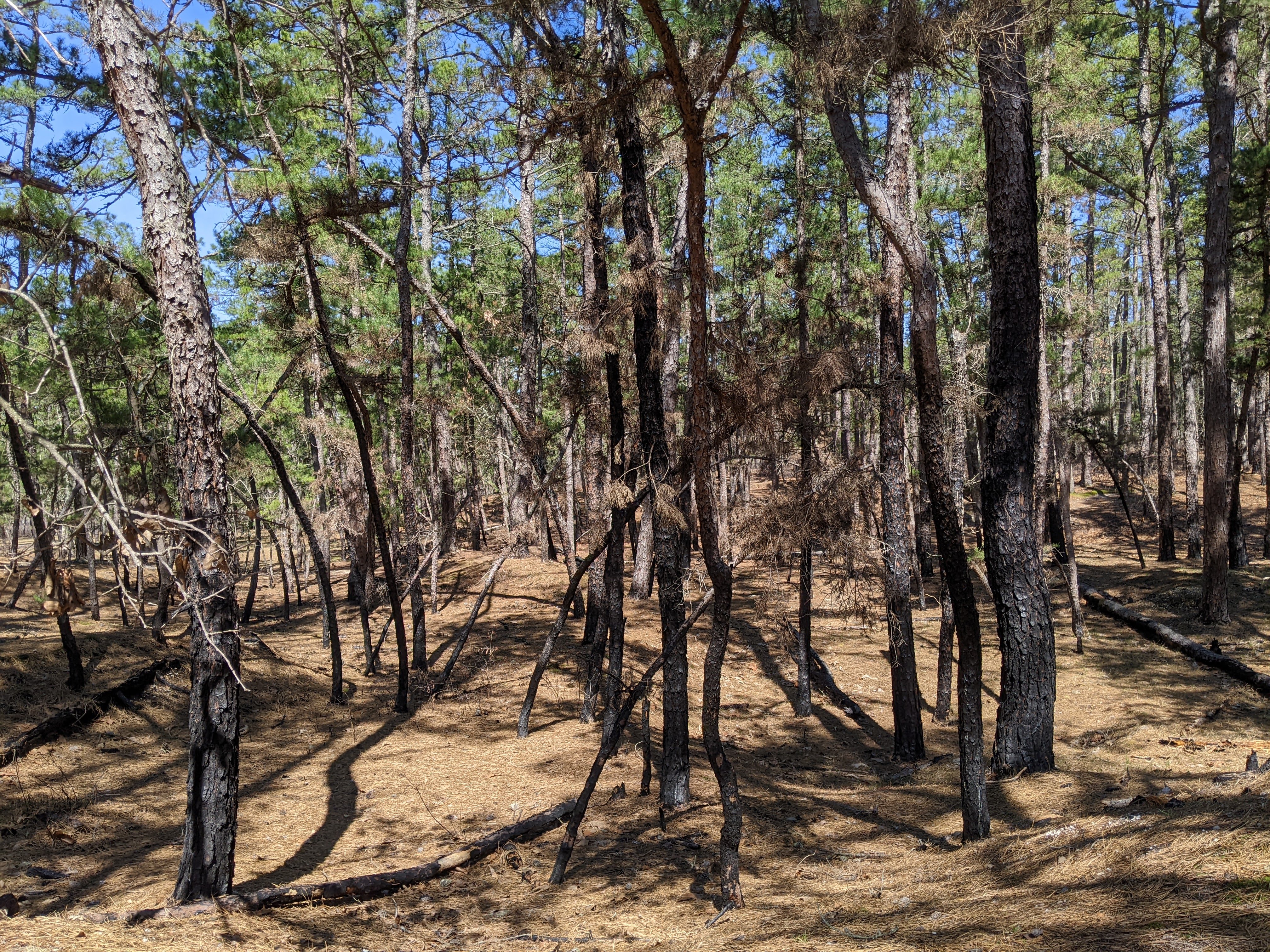
We quickly learned the difference between the two dominate pine species, Short-Leafed and Pitch Pine. The Short-Leafed Pine stand straight and tall. It and it was easy to see why colonial shipbuilders logged the pinelands for this species. The Pitch Pine is clad in very thick plates of bark that protect it from fires and its branches and limbs go this way and that, giving it a wild-haired look. Between the Pitch Pine stands in their fire-proof suits and the Short-Leafed Pines standing twice as tall, flocks of tiny winter birds flitted past. We counted by sight Red-Breasted Nuthatch and Ruby-Crowned Kinglet along the Batsto River in stands of Atlantic White Cedar. By sound we counted Pileated Woodpeckers, Mourning Doves, and a Red-Shouldered Hawk.
 |
| Short-Leaf Pine |
From the Visitor Center we followed Batsto Lake Trail along the river for the first half of our hike of four miles and a portion of the long-distance Batona Trail for the second half. Tops of old dunes and overlooks above the river provided some expansive and intimate chances to observe the life of the forest and wetlands. A pair of Tundra Swans bathed upstream in a big splashy ruckous. Canada Geese yodeled at us from across the river.
 |
| Batsto River with a new admirer |
Kenzey lives in Delaware and knows well the hassles of the bloodletting season. The pine barrens can be miserable at the height of summer bug time. Hiking in winter is much more enjoyable for both of us and we especially liked not having to deal with biting flies, mosquitoes, and midges as we slowly made our way around the four mile loop. Bufflehead Ducks and Canada Geese scattered from a cove on the river as we wove our way through blueberry thickets down to a bench. A pair of Dark-Eyed Juncos tolerated our listening session as they picked through the duff under stunted oaks.
 |
| Ice edge on a black river |
The cold wind plied the banks of the Batsto River and we got a bit chilled so decided to head back up to the main trail and find a sunny place to sit for a snack. Before long we found a white sandy patch, the remains of an old dune blow-out. We basked in the warmth of the sun while gnoshing on pepperoni and cheese with a chaser of green tea. We pondered the old dune and how the seas rose and retreated 15 time during the Cretacous and Tertiary Periods, 135 million to 5 million years ago. She's a lover of paleo-everything and aspires to be a paleo-artist. She gave me a thorough accounting of what creatures may have swum in those deep seas all that time ago. The Atlantic Coastal Plains are layered with strata from many such events and in the barrens there are 13 different soil types! The most abundant soils are highly acidic and found throughout the highlands where only the toughest plants can grow in these nutrient poor environments.
 |
| Tannins color the water blackish-red |
Sandy soils are very porous so rain and snowmelt is quickly filtered through. The water table is high - in some cases only two feet from the surface. The pine barrens sources all its own rivers and streams from the aquifers that lie within its boundaries. All the wetlands - bogs, swamps, and fens- are fed by waters that rise from these lands.
 |
| Ancient sand dune blow-out patch |
At the Batona Trail intersection we turned right and walked for two miles on the only long-distance trail of 50+ miles in the region. On a paper map I showed her what those thin contour lines meant and we felt the ground rise as we walked to the summit point of our hike at 625' where there was another bench and another listening session. We followed the height of land along a sandy ridge where in the last few years a big fire must have roared through. The tops of the pines were charred and the canopy of pine needles that still clung to the trees were burnt rust and brown. Side-sprouted bunches of needles proved that some trees survived but there were plenty of dead fallen trees to work around.
 |
| At the intersection of the Batsto Lake Trail and the Batona Trail - turn right |
Fire is the single most important factor in the pinelands ecology. It is now the season of controlled burns and we could smell the piney smoke from a fire not too far away. I told her about the few times I served on control back burns when I worked with DNR. T described what the woods might have looked like with burn crews making their way along fire breaks or moving with the low waves of flames through the woods with their pulaski tools, backpack water pump tanks, shovels, and broad rakes.
 |
| Batona Trail enters a burn area and baby pines are everywhere. |
Some species of pine set hard, enclosed cones that require the heat of fires to pop them open and spread their seeds. Fires sweep out ouchy Greenbriar thickets and reduce any leafy material to ashy cover. Seeds may set where they drop or travel on the wind and lodge into bare soil further on but soon the grey forest floor will erupt into a pine nursery underlain by sheets of grass and fern.
 |
| Pine Savanna |
The Pine Barrens of New Jersey were some of the first publicly owned woodlands in the nation where fire was used as a management tool. In the late 1940s local burn management units went against prevailing national policies of fire suppression. But the NJ foresters proved
with evidence that unburned pinelands will transition to oak and other deciduous cover so quickly that dropped leaf litter of only a few years is enough to prevent young pine seedlings from surviving. Heavier seeds like acorns and nuts can penetrate leafy floors but no so the pine seedling with has delicate threads of roots that cannot reach or hold on to detritus littered floors.
 |
| Pitch Pine charred bark |
The practice of controlled burns may have started with indigenous people who set fires to promote grass savannas beneath the trees. These grasslands maintained preferred species of game animals like deer. Left unburned for ten years, a heath bush like blueberry and huckleberry will follow. As we walked along we noticed five different stages of fire recovery from early savanna, heath barren, scrub forest, pine nursery, and mature forest. Still listening, we added Turkey to our bird list as a flock squabbled and gobbled in the not-to-far distance. They remained unseen however, hidden in low roll of grassy hills.
 |
| Silence stop. |
Silence is one of the major thresholds in the world. Meister Eckhart said that there is nothing in the world that resembles God so much as silence. Silence is a great friend of the soul; it unveils the riches of solitude. It is very difficult to reach that quality of inner silence. You must make a space for it so that it may begin to work for you. In a certain sense, you do not need the whole armory and vocabulary of therapies, psychologies, or spiritual programs. If you have a trust in and an expectation of your own solitude, everything that you need to know will be revealed to you.
- John O'Donohue, from Anam Cara (1996)
 |
| Puffballs |
Though it was too cold for snakes, salamanders, frogs, and toads, we promised we'd come back in the spring to camp overnight and do a night hike to a bog or vernal pool. My favorite snake is the Pine Snake and I shared with her how I helped to raise one when a nest of eggs was found raided by a predator and my ranger friend needed helpers to incubate and raise any surviving babies. I received two eggs, but one did not hatch. But other egg did hatch and that tiny creature grew into a big, beautiful Pine Snake that two years later we drove back to the pine barrens to release where the damaged nest had been found. I like to think that somewhere in these woods there are the descendants of Ranger the Pine Snake.
 |
| One last listen before people, roads, bikes, and dogs .... |
The silence of the woods was what made the greatest impression on my grandchild. She stopped often to stand or sit - just to listen. When the wind had calmed, the depth of the pinewood's silence was profound. She was moved by it - as was I. We need to bring our children into the silent places. Let them drift into the heart of a quiet pinewoods and discover silence on their own terms. Given them the chance to experience it before their busy lives as adults overtakes them. They will come to honor it and maybe even love it - the quiet woods.
Do not try to serve
the whole world
or do anything grandiose.
Instead, create
a clearing
in the dense forest
of your life
and wait there patiently,
until the song
that is yours alone to sing
falls into your open cupped hands
and you recognize and greet it.
Only then will you know
how to give yourself
to the world
so worthy of rescue.
- Martha Postlethwaite
 |
| Jersey Devil fan and her grandmom. |
The thrill of the day was learning about fire ecology and fire-dependent forests. I know that she will always remember the encounter with a ranger who flagged us over as we were leaving the Visitor Center for home. He invited us to watch with him as a charred log began to smoke and crackle, a full 24 hours after the fire had been suppressed. "Fire is a friend to this forest," he said, "but it's a friend you have to keep an eye on so that he doesn't get into trouble!"
Notes:
Wharton State Forest
https://www.state.nj.us/dep/parksandforests/parks/wharton.html
The classic field guide to the New Jersey Pine Barrens is Howard Boyd's
A Field Guide to the Pine Barrens of New Jersey: Its Flora, Fauna, and Historic Sites (1991). I now carry this in my Kindle Library and we had a good time researching our finds using Kindle on our phone.