Monday, August 12, 2024

UT - Lapointe Trails - The Corkscrew


On a recent visit to the high desert region of Northeast Utah with my eldest grandchild, I had the opportunity to hike alone into the red-banded hill region of the desert west of Vernal. Koda was busy at the field station museum in town and I had the morning to explore. Hot and dry and at altitude, a mile was all I could manage as an out-and-back, and with no one knowing where I was, I didn't want to take chances so I kept this little excursion short.  Fully hydrated with a text message sent (but not acknowledged) with my location, I followed the hiking and single-track Lapointe Trail favored by mountain bikers. I could see the path flow up and around flat-topped hills of red sandstone and wished I'd had rented a bike! Named the Corkscrew Trail, it was one of two loop trails that make up the Lapointe Trail system near Lapointe, Utah. 


Sagebrush


The scent of sagebrush filled the air and with every step a cloud of red dirt dust swirled in the slight breeze. I looked for pottery sherds in the wash and found a few, left in place but sketched into my sketchbook as I went. Most were grey clay but one little piece had the black and white pattern so familiar to desert dwelling peoples of centuries ago. I admired the small artifacts where they lay and considered how the desert itself is an artifact of expired inland seas and of contemporary imaginings of the desert environment. This place checked the box for stereotypical desert, but of course all deserts are ecologically, geologically, and culturally different from each other. 
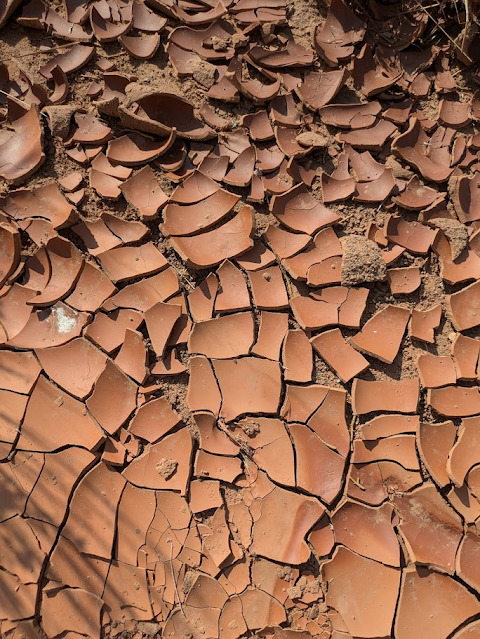

Mud-crack in a wash


I watched a little Whiptail Lizard wriggle-run her way across the bike tire tread tracks and into a shady hole. I studied her tiny trail thinking I'd found a real treasure only to look up to see a dozen baby Whiptails racing here and there, chasing flies, scurrying beetles, and big, fat Harvester Ants. They were everywhere all at once. Imagine them the size of a small Allosaurus, traveling in a herd like this. I wouldn't stand a chance! 


Whiptail Lizard tracks


I had only gone a half mile before I realized that there were no landmarks to navigate by, except to look back over my shoulder to see the rental truck parked in the distance at the trailhead. Everywhere else I looked, north, south, west - all looked the same. The same sagebrush flats, the same flat topped hills, the same red dirt, the same smoke-hazed horizon.  The ages and ages of sameness of this place, its thousands of years of head-splitting heat and bone jarring cold, flat, tedious, dusty - it made me feel very small indeed. Like a grain of red sand. I felt like I had been out here for a million years, yet it had been less than an hour. 


Prickly Pear Cactus

I wandered down the broad wash to look for more sherds when a mountain biker appeared out of nowhere pushing his carbon-framed bike down the single track and looking totally pissed off. I met him later in the parking area at the trailhead waiting for a ride to the trailhead miles away where he'd left his car and his extra tubes and patch kits. "Bloody cactus!" he said, smiling wryly. He looked like a god that had jumped out of a cliff carving, a petroglyph warrior wearing his head dress helmet and armored plastic shin protectors. 


This is the Hour of Land, when our mistakes and shortcomings must be placed in the perspective of time. The Hour of Land is where we remember what we have forgotten: We are not the only species who lives and dreams on the planet. 

There is something enduring that circulates in the heart of nature that deserves our respect and attention.


Terry Tempest Williams from The Hour of Land: A Personal Topography of America's National Parks 


Notes:

Steven Simms, (2016)   The Fremont Period   https://historytogo.utah.gov/fremont-indians/
Terry Tempest Williams (2016)  The Hour of Land: A Personal Topography of America's National Parks 


Friday, August 2, 2024

Mossy Thoughts

One of the  things I was very tuned in to during our summer visit to Cook Forest was moss. So much moss! Someday I'd like to take a class in bryology to understand more about it.  I do know, for instance, that mosses have no roots, thus deriving everything they need from the air and surface water that accumulates on them. But other than being familiar with a few sphagnum mosses and temperate woods varieties, I feel like there's a whole universe of mossy knowledge out there I am craving.


Cooksburg Cemetery 


My first foray into the literature of moss was to read Robin Wall Kimmerer's Gathering Moss (2003). Kimmerer writes from the vantage point of a young bryologist who, like many of us, notices the wonderous close-at-hand by simply exploring the woods beyond her cabin home. We needn't go far to be lured into the world of bryology. But most importantly, she makes the connections between the worlds of moss and the worlds of people. She stresses science and folk/indigenous wisdom simultaneously, drawing us into very familiar yet alien landscapes of the small and magnificent. 

There is an ancient conversation going on between mosses and rocks, poetry to be sure. About light and shadow and the drift of continents. This is what has been called the "dialect of moss on stone - an interface of immensity and minuteness, of past and present, softness and hardness, stillness and vibrancy, yin and yan.  - RWK Gathering Moss


Cooksburg Cemetery


Together with their lichen neighbors in magic-making, I was captivated by how colonies of moss were to be found everywhere on our NWPA adventures from the ironclad belly of an 1800s steam engine to a wall of rock so sheer that nothing else could gain cling except moss. Our visit to Cooksburg Cemetery was a feast for the bryologist's eye. Here I was bowled over with the sheer variety of moss species growing over old gravestones. Whether these human dead and buried had been good church-going people or just on the fringes of religion, the mosses were covering over and filling in a hillside of mortal names and dates with little regard for who or who wasn't God-fearing a century or more ago. 

Drake Well Museum, Oil City

Revered bryologist and northern woods naturalist Jerry Jenkins, a founder of the Northern Forest Atlas Project (see Notes), explains that groups of mosses can be sorted by the surfaces they find most agreeable. There are groups for temperate forests and for boreal forests. There are moss maps that describe moss groups most likely found on permeable or non-permeable surfaces. There are moss groups for seepages, fens, temporary pools, sand, gravel, burnt ground, biocrusts, pavement, masonry, and bare rock. There are moss groups for marshy hummocks, soil banks, and xeric ridges and crests. There are mosses found only on unshaded sites and mosses found only on deeply shaded streambanks. 


Beartown Rocks, Clear Spring State Forest 

Jenkins points out, however, that as a "supergroup" of living organisms found all over the world except for Antarctica, they are vulnerable to many threats and that we shouldn't take any of our mossy landscapes for granted. Climate disruption, fire, development and habitat loss, disease, and air pollution are just a few threats mosses face. Now I'm even more intrigued. Maybe someday I will take a class from Jerry, although something tells me not to wait too long! 


Class announcement from last summer. Sigh :( 

So how does an ancient organism like moss survive without a vascular system? Bunching up together helps support individual mosses so being short and close is advantageous. Bunching also helps conserve water. Despite its abundance across a hundred different and diverse habitat types, it does require ecosystem stability where osmosis can occur consistently. Osmosis is absorbing atmospheric or terrestrial sources of water and though moss does act as a filter, it can also collect or bioaccumulate toxins from polluted water or air it absorbs. Moss is a photosynthetic powerhouse and forms the base of many ecosystem food chains.  I'm thinking about mosses primarily close-to-home as Robin Wall Kimmerer has taught me through her books and work in the Northeast, but now I'm excited to look for them in the Rockies and deserts of Utah and Colorado - my next adventure with my paleo-adventure pal Koda, eldest of the grands, next week. 


Haircap Moss, Cook Forest, PA 

It’s life, and ours, exist only because of a myriad of synchronicities that bring us to this particular place at this particular moment. In return for such a gift, the only sane response is to glitter in reply.  - RWK Gathering Moss


Notes: 

Northern Forest Atlas Project - "Moss Lessons" Jerry Jenkins (2020)

Northern Forest Atlas https://northernforestatlas.org/

Robin Wall Kimmerer, Gathering Moss (2003) 


Tuesday, July 30, 2024

DE A Coastal Birthday Reflection

On a recent coastal excursion, a birthday gift from my daughter (who l lives in Lewes, DE), I had the time to reflect on the changes I've witnessed to this section of Atlantic Coast where I grew up spending summers 'down the shore" with my mom and siblings.  Mom rented a small bungalow on a bayside street in the ocean town of Dewey Beach where with a dozen other working class families who we lived next to, played and ate meals with, and fished alongside spent every summer. 


For over fifteen years, the Delaware Coast was my summer home and I had extraordinary freedom to ride my bike, paddle our canoe, and walk just about everywhere. Out the back door were wild dunes and coastal forests. Out the front door was the sand-over-asphalt street lined with neighbors trucks and cars and boats. No one ate out. We fished for our meals with crab, flounder, and drum (thanks to our neighbor's abundant catch off the breakwaters),  and may favorite - sea bass. I got to know this landscape intimately and loved it dearly. That was fifty years ago. 


Now I hardly recognize the places we once walked, rode, and paddled. Traffic snarls on the main highway are commonplace with four-lane highways backing up against frequent accident scenes and crowded holiday weekends. For miles and miles pavement has replaced oak, pine, and holly forests where now hundreds of shopping plazas, outlets, fast food places, and housing developments sprawl almost to the waters edge. The walkability of these places is questionable if not dangerous. As I sit in the bow of the boat scanning the coves and inlets for pelcians and dolphins, I mention how rip-rap has replaced nearly all of the marsh-bound shore along the Delaware Bay side. No more half moon beaches or rickety piers to tie  a few crab pots to. My sister, along for the ride, mentions that high tides daily flood her street when only three decades ago, this was not a common occurance. 


Sea level rise threatens much of the U.S. Atlantic Coast and for some areas like coastal Virginia and North Carolina, the impact is severe. For those who live further back from the beach like my daughter, flooding from intense rainfall events turn neighborhoods into standing lakes drowning roads and sidewalks. High tides along the tidal creeks and rivers push farther and farther inshore killing swathes of what coastal forest remains. I think outloud "All in my lifetime."  I look at my grandaughter riding the bow, laughing at getting soaked in salt spray as the fishing boat rolls and pitches on the ocean beyond Cape Henlopen. How can I ever explain that her world  and mine at her age were entirely two different worlds? 


I might have felt it in my blood, you know,

the terrible changes that would come to take my memories,

my anchorage, my belief in a single god.

For how could anyone, believing in such a god -

God of love and Creation-

have done such things to the places

where sea breezes made gnarled pines sigh

and wild dunes hum, crowned with grass

above the highwater salt scrub, full of Myrtle Warblers?

The knife turned under their ribs as

cash money promised to make gods of them all

where no longer a day's catch filled their bellies

but the bounty of another ocean shipped across the seas

heaped upon the new believers in 

progress advances.

Gone are the crescent moon beaches where horseshoe crabs 

over their millions of years once gathered and to feed

Red Knots on their way to the Arctic.

I guess we are all trying to find another way

to survive, but I'm not sure this is it. 

I'm not sure I can tell the story 

without mourning out loud 

what others find it hard to imagine. 


Notes:

NASA " Can't See Sea Level Rise?" May, 2020.  https://science.nasa.gov/earth/climate-change/cant-see-sea-level-rise-youre-looking-in-the-wrong-place/

Sea Level Rise and Delaware's Wetlands https://dnrec.delaware.gov/watershed-stewardship/wetlands/and-sea-level-rise/

NJ Spotlight News. May 2023. :Along the Delaware Bayshore, Hoping for a Future for Horsesshoe Crabs. https://www.njspotlightnews.org/2023/05/conservation-efforts-for-horseshoe-crabs-working-on-delaware-bayshore/


Tuesday, July 16, 2024

PA Forest Cathedral Natural Area, Cook Forest State Park

Note: None of these pictures comes anywhere close to doing this old growth forest experience justice. That said, here's our hike through the Forest Cathedral Natural Area in Cook Forest State Park in NWPA for a circuit hike of three miles. 

Laura among giants

Our definition of what is considered to be old growth forest have been shifting as more scientific and cultural history of these ancient places emerges. This tract of 400 acres embedded within Cook Forest State Park is an easily accessible (multiple trailheads and parking areas) designated natural area where we can see how and why those definitions have changed over time. Sure, there are BIG trees, but there is also an abundance of downed trunks that decompose into rich soils, huge standing snags that harbor multitudes of species, and a rich understory that has grown from nurse logs and nursery stands around parent trees. Add to that, some of the biggest live trees we saw (including all of the trees smaller than them) were growing from ancient rootstock, stumps that may have been several hundred years older than the centuries-old trees that grow from them now. 


Trailhead at the CCC "Log Cabin" access


White Pines, each 350 (l)  and 250 (r) years old


We spent a solid day exploring the Forest Cathedral Natural Area and throughout the week we dipped into it from several access points. We initially entered on a loop trail that began with a steep climb from the Indian Cabins area, but later found accessible entry points at the Log Cabin EE Center (CCC) parking area, the Sawmill Center for the Arts, and even our campground trail system which bordered the natural area. Our campsite at the park's Ridge Campground was surrounded by old growth Hemlock and White Pine. For our first experience of this forest we chose to do a loop that connected several different trails to bring us back to the Indian Cabins area. 


North Country Trail


Joyce Kilmer Trail


All the trails were wonderful as we wandered along well-maintained paths. We met up with a few other hikers who were just as in awe as we were. My favorite section was walking a mile of the blue/yellow blazed North Country Trail - the longest long distance trail in the U.S. at 4,000 miles! The forest was massive and it took our breath away more than once, leaving us uncharacteristically unable to speak. There was so much going on from craning our necks to see the tops of the ancient Hemlocks and White Pine, to crawling around on the needle-soft floor to look at mushrooms and massive trunks of old giants, that I needed a break to adjust to the constant state of overwhelm I was experiencing. 


Xylaria sp. 


Pleated Pliteus


Ghost Pipe


Coral Fungus


Pennsylvania was one of the most heavily logged over states in the U.S. when, by the outbreak of WWI so little remained of its once dominant old growth forest that Governor Gifford Pinchot who served earlier under President Teddy Roosevelt as the first director of the U.S. Forest Service, deemed the restoration of PA's forests a priority under his administration in the 1920s. It was during this period of intense tree planting with community-based conservation programs that the template for a national Civilian Conservation Corps was formed. President Franklin Delano Roosevelt (cousin to TR) elevated the CCC to national service and many of the trails we hiked on this day were created both by the earlier PA and New Deal National CCC service boys. But the fight to save the Cook Forest began a decade before when Gifford Pinchot served as Forestry Director under Governor Sproul in 1919. 


Sandstone block island forest


Sky openings and young trees


Private landowners, especially those who owned large tracts of forest for logging interests, became aware of the danger to undisturbed forests in their holdings as demands for lumber sky-rocketed during WWI. At the same time, conservation interests began to raise the alarm for the protection of what was left of the old growth landscape in Pennsylvania. The Cook Family who originally owned the vast forests that now make up Cook Forest State Park entered into a project with several Pennsylvania conservationists to preserve their old growth tract, a project that would take 16 long years to complete. The process was rife with politics and big industry interests where "sinister interests were at work there." (McCreight 1936)  The arduous campaign to save Cook Forest resulted in the creation of the Cook Forest Association in 1927, now the Cook Forest Conservancy and is very active today. 


Indian Trail 

As we climbed the steep-sided valley on the Indian Trail we sunk into a forest tapestry of young, old, and very old trees while the ground cushioned our steps with layers of short needles of Eastern Hemlock and soft long needles of White Pine. We talked about our we interpret time among the old trees where a human life span was inconceivably short when compared to the multi-generational stump nurseries that spanned a thousand years or more of forest growth. The intelligence of trees, as some scientists and artists suggest, is imposed over a timescale so vast that to our minds, it is near unimaginable to think of what kinds of wisdom they hold and transmit. Even the new definitions of what is old growth seemed inadequate, even trivial.


The start of a Horses Hoof Fungus


Dog Pelt Fungus


I considered the idea of regeneration as we walked, passing rotting carcasses of ancient trees draped in moss, lichens, and fungal forms. Indigenous mythologies are full of stories of rebirth arising from ancient landscapes and this forest seemed full of stories. The Seneca People who once lived, fished, and hunted throughout this region (and who maintain an active presence in local conservation efforts) held in high regard the transformative, restorative powers of Storm Wind, Dàgawanoeient, and the Ga-Ha, the Zephyr - great winds that could level giant trees thus starting the process of rebuilding real and spiritual relationships with the land. 


Allegheny Dusky Salamander


We passed an old tornado path (1970s)  and later studied the effects of a more recent microburst. New forest was evident everywhere. Change and regrowth was the constant. Even in a small circle of sun where a single giant had died and its canopy no longer shaded the forest floor, young vigorous Hemlock and Pine were pushing to the sky. Storm Wind and Zephyr sure had a time of it in this old woods. I gave a little shudder imagining what this place would sound like during a major storm! 

Sister trees on a long sit-down

Nearing the bottom of the steep valley path that combined the North Country Trail with the local Baker Trail, we came across some wonderful seeps and springs flowing out of the big hill above. I flipped a few rocks and discovered a few Allegheny Dusky Salamanders. The almost level ground invited straying off the path to find tree and rock formations that made us smile. Two bridges, a truss and suspension, carried across and back over Tom's Run that we followed to our starting point at the Indian Cabins circle. 


Truss bridge over Tom's Run


Suspension Bridge over Tom's Run


We drove up the hill to return to our campsite on the edge of the great woods, ready to make our supper and settle in for the night. Two enormous White Pines and a crowd of mature Hemlocks surrounded our little site perched on the edge of a ravine, where waters flowing quietly to Tom's Run began a steep downhill run. That night, snuggled into my truck with a very tired Amos the Coonhound and my open journal, I made a note to find the full text of Mary Oliver's "Sleeping In the Forest" because I could only remember one line "I had vanished at least a dozen times into something better..."


Our nearby Ridge Campground (left) and Forest Cathedral Natural Area


Sleeping in the Forest

I thought the earth
remembered me, she
took me back so tenderly, arranging
her dark skirts, her pockets
full of lichens and seeds. I slept
as never before, a stone
on the riverbed, nothing
between me and the white fire of the stars
but my thoughts, and they floated
light as moths among the branches
of the perfect trees. All night
I heard the small kingdoms breathing
around me, the insects, and the birds
who do their work in the darkness. All night
I rose and fell, as if in water, grappling
with a luminous doom. By morning
I had vanished at least a dozen times
into something better.

- Mary Oliver, from the anthology Poems to Live By in Uncertain Times (2001)


Journal page July 7, 2024

Night sounds included a sleepy but hungry Raven fledgling, raiding raccoons, and a big Black Bear who seemed to enjoy bumping into the truck and Laura's car as a matter of nightly routine. Amos snored on, unfazed by Sir Bumps-A-Lot. Our doors were locked and all our food stored out of sniff range safe inside so no bear encounters over meals happened to us though our uphill neighbor was paid a very loud cooler-left-outside visit at 3am. Such is life on the edge of the Big Woods.


Site #30, Ridge Campground, Cook Forest State Park


Notes:

Old Growth Forest Network description for the  Forest Cathedral Natural Area 

M.I. McCreight (1936) Cook Forest Park: Story of the Sixteen Year Battle to Save the Last Stand of Historic Penn's Woods - the when, why, and how of it. Archived in the online collection at Penn State Universities Library https://digital.libraries.psu.edu/digital/collection/digitalbks2/id/9472

Cook Forest Conservancy  

Mary Oliver, Poems to Live By in Uncertain Times  

Monday, July 15, 2024

PA Beartown Rocks, Clear Creek State Forest

Beartown Rocks, Clear Creek State Forest, NWPA (2 mile loop hike)

Each enormous block of resistant Pottsville Formation Sandstone was like an island to itself. My sister and I wandered around for over an hour in this rock city located on a ridge in Clear Creek State Forest atop the Allegheny Plateau in Jefferson County, PA. Some blocks contained curtains of ferns, other had small forests growing on top. Rock cities are cool to explore wherever  you find them, but Beartown Rocks seems especially magical. 


The opposite of mountain terrain, this is incised, heavily eroded landscape is caused by downcutting streams and freeze-and-thaw cycles over 300 million years. We were just south of the ice line that marks the extent of the last glacial period, so this topography has not been polished, moved, or dumped on. The formations here are weathered but edgey, pitted and pocked by moving water not ice, and pried by tree roots.


Caprock sandstone 


Flowing water created pockets in softer layers


Passageways are old water courses

Pottsville Formation Sandstone is found from Western New York and Western Pennsylvania, West Virginia and Virginia and all the way to Northern Alabama. The Allegheny Plateau contains many popular parks where this predominate rock type creates similar rock cities found at World's End State Park in PA or form high waterfalls like Blackwater Falls in West Virginia. Nearly horizontal layers of sandstone are interspersed with beds of limestone, siltstone and heavy shales (which contain oil, coal, and gas). From the overlook platform, the horizon is flat to gently rolling hills. All the deep valley topography happens downslope from where we were and the trails leading from the plateau to the valley bottoms can be quite steep and rocky.  


Beartown Rocks Platform  

Coarse-bedding of highly resistant sandstone

Trace fossils of sea creature burrows 


The island-effect was really captivating. Each large block contained its own arrangement of plant life including trees, ferns, mosses, and lichens. No two were the same. As we wove in and out of the narrow passageways, we discovered that each island also weathered differently too. Some blocks stood upright, level on top, allowing trees to grow as little groves. Others were tumbled sideways or slipped downslope a little. Caves and ledges were everywhere.


A forested island of stone


Dry liverwort adorns a ledge


The latest heat wave and drought was beginning to take its toll on the dry forest along the ridge. Many trees were shedding leaves and these crackled and crunch under our feet. Mosses, liverwort, and fern that lined the walls and ledges of the great blocks of stone were looking a little distressed. We decided to try one of two loops on the Beartown Rocks Trail and see if we could find a few seeps and cooler temperatures. 


Crumbled blocks


Dry mosses await rain in scour pockets


Trail intersection for two loops


As we descended into the valley we noticed right away the vast fern fields - a sign of abundant deer herds. They eat the understory right to the ground leaving a post-logging woods bare of succession. Nearby a very large deer exclosure wrapped around an old farm field that once belongs to the family who farmed this broad slope. It looked to be working as sapling hardwoods were bursting skyward behind the protective fence. Downslope from the exclosure we crossed several springy seeps.


Eastern Teaberry


Fern fields and no understory

We opted for the shorter loop of 1.8 miles around due to the heat - remembering that for every step down we'd have to step back up! The exclosure to our left and walking on a gas company road we noticed how lush the edges were, full of wet meadow plants blooming in the sun. Spotty shade and frequent breaks helped Amos manage the heat. 

Meadowsweet


Within the hour we were back at the truck in the main parking area, which had filled up with visitors. And, predictably, there were herds of deer nearby! 


Entrance off of a forest road - Corbett Road. 

Notes: 

Beartown Rocks is found in the state forest with the Clear Creek State Park very nearby. In this region there are many state forests and state parks embedded within the larger landscape of the Allegheny National Forest.