Sunday, May 24, 2020

PA Duncan Run Bushwack


Trails are crowded. Parking lots at local parks are packed. People have discovered the importance of outdoor time and space as the lock-down weeks roll on into months. As some states are beginning to lift restrictions on travel and business operations, I wonder what effect this will have on this new-found appreciation for nature and open space access? Or will everyone just go back to shopping, sports, and eating out?

Metasedimentary outcrop is the bedrock for this deeply eroded ravine creek.

Today I decided to skip the crowded parks and go for a bushwack in one of the nearby PA Game Lands units. I set out to find Duncan Run, a deep-down walled-in river hills creek that I've only seen on maps. It was quite the scramble down and would have been a tougher climb out had it not been for Amos pulling me up the whole way. I had him on his 30' lead with a carabiner attached in case I needed that line for lowering into tight spots or hoisting either of us out. I was nervous about this adventure, I have to admit. It was extreme social distancing to be sure and I did tell a hiking buddy where I was going and how long I'd be there.


Jack-in-the-Pulpit

The definition of bushwack is "to travel by foot through uncleared terrain," and I put on my best William Bartram foot forward. Philadelphia naturalist and botanist, Bartram was best known for his bushwack walking through the American Southeast, but his twin sister Elizabath, who died in 1824 is buried just across the river, and was an able botanist herself. She was married to William Wright and lived in the wilds of Lancaster County near the Conestoga River, very close to the last Susquehannock village towns.  Indian Run creek came close to their farm and where it emptied into the Little Conestoga Creek and down to the main stem of the Conestoga River was where the native people of this watershed tried unsuccessfully to maintain their communities. Across the Susquehanna from where I stood on a thin vertical slice of ridge, I could see straight across into Lancaster County while below was the rush of Duncan Run tumbling east to the river.

Striped Cream Violet, Viola striata


Bluets and Stargrass on rocky ridges.

Before descending I checked out the moss and lichen communities and a small vibrant patch of Eastern Daisy Fleabane that grew in a sandy bowl of mineral soil. These rocks are the remains of old sea bottom, metasedimentary rock that is highly contorted, bent, and deformed due to continental collisions. The slopes are full of sharp talus plates, shed like spines, or eroded into stacks.

At the end of a spine, 120 feet above the river. 


Stone stack surrounded by talus scales popped off by tree root expansion

Climbing down into the valley I found several micro-habitats formed in the talus. Small sheltered coves held moist soils where Wild Geraniums grew. Amos found a very old male Box Turtle scooting along a wide mossy ledge. He was completely unafraid and tolerated me posing him for a shell picture. I doubt he's ever met dog or human before. Just as curious about me as I was about him, he never withdrew and instead extended his head out fully to check me out. Off he went in a turtle blur of speed when I set him back on the ledge. I watched him nimbly pick his way up and up until he scooted around a stone stack and was gone. No ropes needed.

Wild Geranium


I butt-scooted about twenty feet down from ledge to ledge, nervous about standing up. I didn't want to slip and fall down here!  Amos was like a mountain goat and made it to creek long before I did. Duncan Run rushed loudly down a series of talus shelves, whisked through slots, and tumbled around boulders. I really wanted to follow it to the river but thought better of it. Best to have someone come along for that bit. This is not the place to go it alone.


Duncan Creek

The air was rich and humid at the bottom. Moss communities smothered every bit of rock.  A fine gauzy green of new growth lay across the rocky banks. A Phoebe darted inside a wide gap between two ledges. No doubt she had a nestlings in there to feed. A family Pileated Woodpecker young squawked for a feeding from a standing dead pine. Amos and I moved upstream to the next spine of rock that towered overhead and climbed up along its side to find a narrow deer path that skirted a cove. We found a nice flat stone stack and scrambled up to enjoy crackers and beef jerky.  The noisy creek tumbled across a set of ledges thirty feet below.


Moss ledges and very sharp seabottom! 

Native Pinxter Azalea.


Virginia Waterleaf growing near the creek.

As I was exploring around the stack literally on my hands and knees - it was too steep to stand - and I gashed my leg on a sharp tree root that stuck out of a crevice. It wasn't a bad wound but bad enough to bleed pretty well, so I slung off my pack and pulled out the water bottle and dug around for my small first aid kit. All the sounds of bags crinkling made Amos think I was getting ready to eat again but when he came over and saw my leg he gave me the most concerned look.


Deer trail across the top of the steep slope.

Amos sniffed the offending tree root, then sniffed the bleeding gash, obviously having figured out what happened.  I'm not sure what the experts say about the cleanliness of dog tongues but I didn't have time to think about it before he started "dressing" my wound. I washed it out with water between licks and held a bandanna, probably dirtier than his tongue, to it to stop the bleeding. Score my first scar for 2020.

Eastern Daisy Fleabane growing on the high spine ridges.
Broadleaved Water-Leaf near the water.

Amos and I had been on our way up and out anyway, but sitting there quietly with the bandanna pressed against my leg gave me a few minutes extra to just listen. An Overbird began to sing, then a Red-Eyed Vireo, followed a Wood Thrush. Surrounded by Waterleaf growing in pockets of damp leaves with the song of Duncan Run below us, we waited a long while before continuing on - long after I'd put the bandanna away. A fine mist of rain started to fall and it was time to head over the height of the hill to the car, a mile through the pathless woods. A good day for extreme social distancing was had by all.


Notes:

Jim Brighton's excellent short-lived blog to the rescue for my violet ID-ing -
http://midatlanticnature.blogspot.com/2012/05/how-to-identify-white-violets-of-mid.html
He went on to create the Maryland Biodiversity Project and can be found there with Bill Hubick, hosting this amazing project online. https://www.marylandbiodiversity.com/index.php

The Spring 2020 edition of Traveller, publication of the Bartram Trail Conference, features the family cemetery of Elizabeth Bartram Wright.  http://bartramtrail.org/resources/Documents/2020_Spring.pdf
(My buddy Dr. Drew Lanham is in this issue, too!)


Wednesday, May 6, 2020

PA Home

These past many weeks - I've lost count - during our COVID-19 shut-down, I've had the time to really observe the changes in my garden, yard, and woods as spring comes on. This remarkable (and sometimes difficult and scary) stay-at-home experience has given me the opportunity to do what I have longed to do each spring, to simply be with the season and watch and listen and be part of the process of its blossoming.

Looking out back, April 20.

My "normal" work life involves commuting, sometimes driving hours a day to offices and campuses and field sites. The drive time is now home time and I am in a constant state of amazement at the numbers of animals and plants here, the birds and reptiles, and even the sheer mass of earthworms and soil life as I turn garden beds. Some creatures are just passing through on spring migration. Others are full time residents. But the members of my hime community that I have most loved watching have been the native plants relocated or nurtured here over the past 20 years. This property was at first a sparse, neglected, and grass-filled space that had been timbered out. Save for a few Red Maples and a grand old Red Oak out back, the place was pretty barren. Now my garden yard has become a haven for native plants and a home for the birds and animals that depend on this habitat. It is shady and complex and full of life.


Hickory planted by a squirrel.


The flames of Beltane

burst green and red

in the woods
where hermit thrush
and catbird
sew together dawn to dusk.
Born again,
in fires of bud burst and becoming,
wildlings hatch,
the door basket
overflows with gifts
of blossoms.

As so noted in the tattered old spiral notebook.


Being home for work has had its own set of challenges. Disrupted sleep patterns. A coonhound that doesn't understand what work time is - if I'm home it must be Amos' time. Being distracted by constantly looking out the window at everything happening out there while I'm locked to my computer screen in here.  It was because of this distracted gazing, however, that I noticed my first-of-year (FOY) Rudy-Throated Hummingbird (May 1), Catbirds (April 19), and Orchard Oriole (April 29). These are birds that nest in my little woods so I have always wanted to catch their arrival date. All three are currently nesting now as are House Wrens, Robins, Carolina Chicakdees, Yellow-Shafted Flickers, and Cardinals. Having noticed the Catbird and giving a WHOOP! during a Zoom meeting was distracting for meeting attenders as well.


Redbud blooming tight to the stem.


Noticing the progression of bud burst and blossoming has made me aware of the changes in my own cycles of concentration, sleep, and creative time. At first, work was still work but it seemed to bleed over into my home life. I may have lost the time driving but I gained extra hours to work on projects and to get things done!  Be productive! Between a torrent of online meetings, however, I suddenly stood up and walked out the door to stretch and noticed a young Pignut Hickory I have loved since it first sprang up - no doubt a squirrel planting. It was unfurling its leaves almost before my eyes. I stood in rapt attention for the entire 30 minute break between meetings. It was that day that I had to put my foot down. Works starts at 9 and ends at 5, I said to Amos (looking unfazed), but it will be interspersed with gazing breaks, bird feeder watching, and tending the veg garden. It seemed I had finally worked out a routine after many weeks of frustration and immediately I saw spring.


Wild Ginger and ground blossoms. 

Turning compost during a break, I noticed just how many insects and worms occupy that space. Amos was "helping" and dug up a startled little Garter Snake. Then another. (I quickly put them back!) I watched Crows raid a Robin's nest and listened as the distraught parents cried and screamed in chase. Bumble Bees weighed the blueberry patch down with their tending to the hundreds of bell-shaped blossoms that promise a heavy crop this year.  A brave little House Wren landed right at my feet to snag a worm from the compost and ducked into the nesting box over the blackberry canes. This was all during a single hour-long lunch break.


Dogwood blooming out front 

These breaks have become creative time for me. I take my sketchbook (when it's not raining) or the old tattered spiral notebook where I jot my thoughts out the porch or deck.  The time after I get up in the morning is now devoted entirely to creative work in the garden and an hour or two writing before I log into my work account. Two mornings ago I walked outside at dawn, put Amos in the fenced yard, and grabbed a shovel to start a new wildflower patch when mommy Opossum carrying two babies on her back wandered over to the freshly turned compost pile and began to forage. I was four feet away and all happily going about digging breakfast. Thankfully Amos was at the far side of the yard engaged in cross-fence discussion with a neighbor's dog, but it seemed that my morning routine is now accepted by all the occupants of this wild little acre.


Robin' Egg

With all this noticing you would think I would know more about the little patch of land I call my own, but that hasn't been the case. The more I notice, the more questions I have and the more I realize I don't know.  When asked about a Robin's egg I found on the ground after a particularly big wind storm a few week ago I realized I couldn't answer anyone's questions. "Where did it come from?" (I assume it blew out of a nest in the wind storm? I don't know.) "Is there a nest nearby you can put it back into?" (I don't know.) It's too big for Hummingbird's nest but will Chickadee raise it? ( I'm not sure.) Is it still viable after a cold night? (I don't know.) "Why is Nature so cruel at times?" (I don't know.)


Sassafras blossoms.

Fighting back the urge to be ever more productive while working from home, I realize I hardly know this place. I wander around and try to remember if I planted this or that or if a Grey Squirrel or Blue Jay planted it for me? Where my dear coonhound Bug was buried last summer between two Redbuds, a little Red Oak is now pushing up. It is a wonderment and I visit it every day.  Maria Popova writes "The cult of productivity has its place, but worshiping at its altar daily robs us of the very capacity for joy and wonder that makes life worth living." This sums up how I feel about where my attention as gone these past twenty years, often working two jobs - at one point three - and hardly having time or energy left to notice the rewilding of my home ground.  


Virginia Bluebells

Maria continues her life-learnings and adds "The flower doesn’t go from bud to blossom in one spritely burst and yet, as a culture, we’re disinterested in the tedium of the blossoming. But that’s where all the real magic unfolds in the making of one’s character and destiny." As I am writing this a cold rain is coming down and the woods around my cabin are practically neon with green. I noticed that when the world is wet and the sky is dull, colors seem to pop and saturate the eye with a riot of tones and intensities. In view of this shut-down and stay-at-home time, my attention to place and home ground has intensified along with the ongoing exuberance of spring and that is more productive for my heart and soul than any project or online meeting.

Stay safe, be well, and take this time to notice.  


Notes:

Maria Popova's Life Learnings essay appears here: https://www.brainpickings.org/2019/10/23/13-learnings-13-years/

Monday, May 4, 2020

PA Old Pinnacle Road Out and Back

May is National Take A Hike Month! At least it is in my house where a walk or hike a day is required for maintaining positive mental health during this long pandemic shut-down.  A few weekends ago Amos and I hiked the Pinnacle Preserve and walked a section of the unpaved Old Pinnacle Road north of Kelly's Run. South of Kelly's Run the old road was paved but it is quickly growing over with vegetation and is part of the Kelly's Run trail system. It's a good hill walk workout!

Old Pinnacle Road closing in with vegetation.

We got a late start after dinner, but it was delightful to walk in cool breeze, no humidity, and brilliant low sun. We began at the Kelly's Run trail head at the old Holtwood Park, now managed by the Lancaster Conservancy as part of the Kelly's Run Nature Preserve. A mile through the woods, across a big bluestem meadow, and down a steep section of trail, then finally to the old road gate that starts a long descent to Kelly's Run at the bottom of the valley, it was all downhill from the car.


Wild Geranium 

On the old road it seemed Indigo Buntings were a dime a dozen darting constantly back and forth across the shrinking pavement surface. A Great-Crested Flycatcher sang from the edge of a small grove of Paw Paw. Yellow-Rumped Warblers flitted through the down slope underbrush. Towhees called from the high slope. Pileated Woodpeckers worked in tandem on a dead standing pine. A Barred Owl called from the hill top. Very birdy!


Wild Radish

Paw Paw blossom

The river hills across the river put on quite a show in the slanting light. From a view point not yet obscured by leaves, the Oakland Run valley was beautifully defined by the light and shadow of the contour of hills. The Mason Dixon Trail runs along the river and right up that valley to the game lands on Posey Road where Amos and I had hiked the day before.


A cross-river view of the Oakland Run Valley and its sister hills


Cascading spring and spring flowers.


Mayapple 

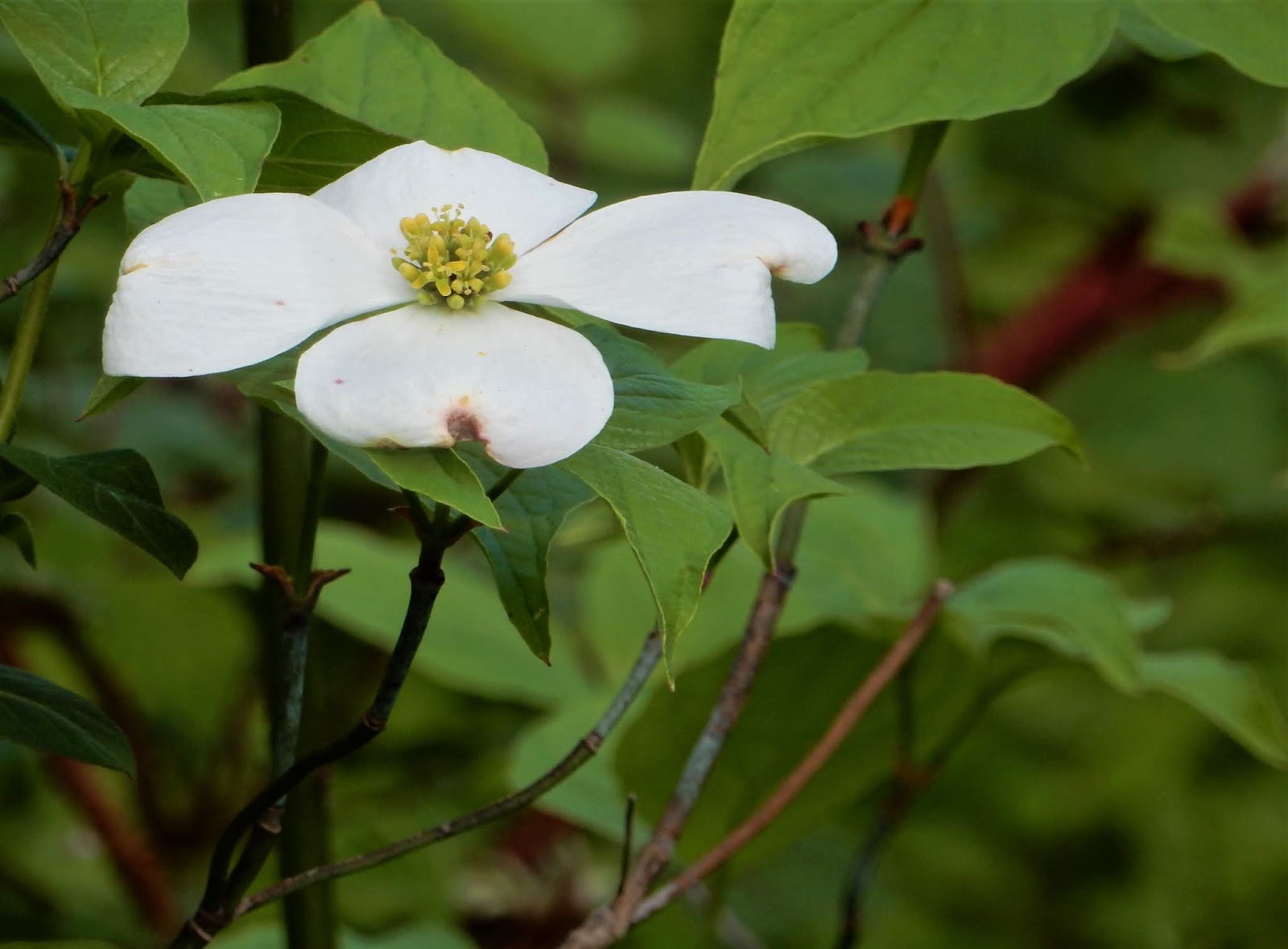
American Dogwood

The road walk is a little under a mile and steady down until it reaches the remains of the bridge that spanned Kelly's Run. It is now a skeletal frame of iron trusses and beams, but still beautiful in form and age.  A Phoebe has built a nest beneath an I-beam and it didn't tolerate our presence for too long. We backed away and slipped down the muddy trail to the creek where the ruins of an small dam are still visible.


At the Pinnacle Road Bridge over Kelly's Run

Kelly's Run and a partial dam ruin

We stayed exploring the creek for a good half hour and when I got chilly I made the executive decision to start the climb out. Even though this out and back is only three miles, one of our shorter day hikes, the hill climb back generated heat through extra calories burned. It was a constant uphill walk from the creek to the gate, then upwards into the woods with a steep final pitch to reach the breezy native grass meadow at the top. Just as the sun was setting we reached the car with a cool drink for Amos and hand sanitizer for me.


Old woods road back

Tuesday, April 28, 2020

PA Game Lands Wander 2

Back out to the game lands for another wandering, looking for sun, exercise, and inspiration. I've lost track of what week it is - for that matter what day it is - but I have enough work to do at my computer that it all runs together anyway, pandemic or not. The local TV weatherperson reminded us four times this week that we've only had five days of full sun for all of April so far. It has been rather dreary, but today offered a nice mix of sun and clouds with morning rain cleared by noon. Off we went to hunt the sun.

Hoping for a break in the clouds on the way to the game lands.

By April all those young beech trees that have been holding on to their paper-thin leaves all winter have let them go as new leaf buds form. The woods looked lighter and greener than ever. Shadbush was still blooming. Wild phlox blossomed along the access road.

Woods road to the bluff

Amos had been very antsy with all the rainy weather so this hike was for him. He snuffled through
every bunch of grass and pile of leaves. He stood with his nose in the air to pull in every scent. He investigated every animal trail that intersected the old road. The road was muddy in spots while  standing puddles filled ruts in other places, but the animal tracks were great. He checked out each and every line, print by print.


At the bluff overlooking the Susquehanna River.

We came to the bluffs that are dramatically visible from the Norman Wood Bridge driving east into Lancaster County. From the bridge you can see the severe tilt of bedrock telling of continental collisions and the raising of mountains further inland. From on top, the view into York County is almost obscured now with the woods finally leafing out. It is a very long way down from here.


Dead Nettle in a clearing


Triple track - White Tailed Deer, Turkey, Skunk

There is a little-used trail that I like to find before the the overgrowth blocks the way but this time I found that it has been well used of late! Seems others have discovered that this game lands tract makes for a nice walk in the woods. I spotted a small patch of trillium and trout lily on the steep pitch many yards away on the slope. The trail slips down to the head of a ravine creek on its way to tumble over the bluff.


Upper reach of a ravine creek.

We were investigating the boggy, mossy hollow when something grunted and squawked higher up the woods. Amos about yanked me off my feet as he pulled up the trail to discover the noise-maker. We never found the source of the sound but his nose was higher than his tail when he reached the gravel road on the far side of the tract. We stood and waited - he sniffed the air and I peered all around. Nothing.

Trillium

While I stood waiting for Amos to do something - I noticed a bunch of trillium almost at my feet.  I don't think I would have seen them had he not stopped at this exact spot. Since this was his hike I let him stand there as long as he wanted while I admired the flowers. After about twenty minutes he was positive that the beasty thing had long vacated the hill.

Successful sun hunt!

The sun shone brightly through a break in a low grey cloud deck and I congratulated Amos on having successfully hunted the sun. He had no idea what I was saying, I'm sure, but he did look immensely proud of himself and pranced up the road to the car where he knew he'd get a treat for such a nice hike.

Thursday, April 23, 2020

PA Game Land Wander

Close to home are four different tracts of land under the management of the Pennsylvania Game Commission. These are public hunting lands where we can go to hunt deer, turkey, squirrel, rabbit, and other game animals to put meat on the table. I'm lucky to have Game Lands tracts of  #83, #181, #288, and #136 near by, certainly within my ten-mile-radius of stay-at-home range.


Pincushion Moss

Now and then a relic of an old farm appears and I am reminded of the families that lived on these old roads. Tractor parts, old pails, farming implements - all sooner or later work their way through the leaf litter.  A slender white-walled tire has become a play ground for fox kits. A locust fence post bears the marks of a buck in rut. 


Battered old bucket


Ruin is in place here:

The dead leaves rotting on the ground,
The live leaves in the air
Are gathered in a single dance
That turns them round and round.
The fox cub trots his almost pathless path
As silent as his absence.
These passings resurrect
A joy without defect,
The life that steps and sings in ways of death.

- Wendell Berry, from Sabbaths - 1979, IV


Ground Pine, a club moss

I love coming across the club mosses since it's a plant that vines through all of my hikes from Vermont and Prince Edward Island to New Hampshire and Wisconsin. It's Pleistocene ancestors towered fifty feet above the ground. There are two places north of here where I can go to find fossilized trunks of the tree-form club moss. 


Sharp-shinned hawk feather

Pattern is everywhere in the old pine woods. From the cross-crossed needles that carpet the forest floor to the yellow-on-green veining of the leaves of Downy Rattlesnake Plantain, my eye is drawn to the way lines and colors compete for attention and how some animals and insects adopt these patterns to blend in with them. Though a hawk feather stands out on the ground, I hold it up against the pattern of the pine branches above and almost lose sight of it.


Downy Rattlesnake Plantain

The pine woods were planted in the 1960s when many state agencies were still adhering to the "plantation" model of reforestation - planting in neat rows all of a same species. The woods in this particular game land are way past their prime and were never timbered out or select cut. It's a mix of dark shade, toppled trees aged out, and a persistent thicket of an understory made up of black cherry and beech that will one day replace the pines and allow other species to grow. 


Dried raceme of Rattlesnake Plantain

A concern for native orchids, however, is plant collectors. I was out walking on sunny May afternoon in a distant tract of #136 and found two very nice folks loading their Subaru with two five gallon buckets of Lady Slippers they'd dug from the forest. They played innocent but I had the sense they were pretty good at what they were doing. I took their plate number down and called my local warden when I got home. He was happy to report that this couple were "old hands" at orchid theft and that the plants had probably already been put into containers and sold, but that he would pay them a visit. I learned later that they were fined.


Wild orchids, like the Rattlesnake Plantain, are commonly found in rich woodlands. Pennsylvania has 54 different species of native orchid found in our woods. The little Rattlesnake Plantain makes its presence known year-round by keeping intact its woody-stemmed raceme that stays erect above the forest floor. One tract of game lands that I love to explore has yielded over a dozen orchid species, but it takes a slow, mindful hunt to find them, and a good bit of bog-edge walking. 


Black Puffball


Spotted Wintergeen

After wandering off-trail through the old pine woods we jumped back on the main trail, an old road, and wound all the way around the tract for a three mile loop. Another cold front was building from the west and the woods filled with mist and light rain by the time we climbed back into the car. 


Thursday, April 16, 2020

PA Pinnacle Trails: Easter Sunrise

For those working through this pandemic in agriculture, healthcare, essential services, and food access - thank you. Even today, Easter, in the early dimness of morning hours I watched the battered blue van on its way to pick up/drop off the laborers who work at our area dairies and processing plants. Amos my goofy black and tan coonhound bounded out of the car to hike one his favorite places. The Pinnacle is adorned with stone walls which shelter his favorite quarry.

Pinnacle Overlook - a wisp of a sunrise

The morning dawned misty and quiet as we began our trek up the Old Pinnacle Road to reach the overlook by sunrise. There were no planes in the air, no cars or trucks or trains but in the empty space of the lost human soundscape suddenly a chorus of bird song erupted from the woods to take its place. Wild geese trumpeted from down on the river. Cattle from a farm across the valley bellowed on their pastures which shone so brilliantly green on the hillside.


Signs of our times. 


We followed the Old Pinnacle Road around to find no sunrise service at the overlook where on most Easters at least two small congregations gather. There were no cars or vans from the local churches and meetings. No one was setting up the coffee and donuts for after service. There was some trash left over from the day before which I picked up - but not much. There was only the sound of the new day dawning.


Old Pinnacle Road is now a blazed trail.

Amos and I made the circuit around the dome of the Pinnacle and followed the old road back to a section  of the long distance Conestoga Trail. Sunrise filtered through high clouds which were drifting in from the south. The Mid-Atlantic is expecting a strong line of storms and heavy rain to begin within twenty-four hours. The muted light, however, made the colors pop a little more and I was amazed at how much greener that far pasture across the river looked as the light brightened.


Vandalism where there had been none before.

The steep rocky trail seemed a bit tired, even haggard. It hasn't seen this much foot traffic in a while.  I picked up more wrappers, empty bottles, and the cap to a spray can left behind after ruining an outcrop with purple paint. People have gone off trail everywhere. Just like my observations of the Mason Dixon Trail last week, too many wandering people - unfamiliar with trail etiquette - have left disturbed paths of exposed worn, thin forest soils. I worried about the impact the heavy rains tomorrow will have on all of our overused trails.


On the Conestoga Trail

Amos was hot on the scent trail of a ground hog. This is his favorite animal to track but I reined him in to slow down on a particularly steep set of rock scrambles. I knew the ground hog den was somewhere in these outcrops and Amos was very excited to find it, but I was worried about being pulled over two hundred feet of sheer drop-off.  We had to have a talk about his trail manners before we went any further.  Collected and careful, Amos walked slowly down the hill without pulling as long as I reminded him to "gentle walk."  The trail reconnected again to the Old Pinnacle Road and we took the safer route rather than continue down the rocky slide.

Rattlesnake Plantain - a small woodland orchid.

An 1864 map shows that the Pinnacle hill, one of the great river hills of this region, was used primarily for timber cutting during the Civil War. It's thin-soils and loose rock  made it hard to farm and was used for pasturing animals after the woods had been cleared. The two creek valleys that define the height of the hill north and south are Kelly's Run and Tucquan Creek.  Where they emptied out into the Susquehanna there were grist and saw mills but most importantly was McCall's Ferry that carried Conestoga wagons and passengers by large flatboats across the river.


Lancaster County Township Map, Marctic, 1864 

The famed wagons were built here in the Conestoga region and are still an icon of the history of westward expansion. McCall's Ferry even had an inn to house those waiting to cross, with stables for the horses and Fisher's provisioning station for long-distance travelers to add to their stocks for the first phase of going west. We walked the old road up and away from the site of the ferry crossing to explore the hill. In the 1850s and 60s Conestoga wagons would have been streaming the other way to make the crossing at the valley below.

An old  PPL company gate is still locked.

When the building boom of the great dam era began in the early 1900s, the Old Pinnacle Road was "improved"  by steam shovels and bulldozers. Used mostly by power company workers who lived in small temporary hill villages, the "New" Pinnacle Road carried tourists as well who made the bumpy ride to the top for the view.  Seeing an opportunity to draw more Sunday drivers and picnickers, Pennsylvania Power and Light developed the top of the hill with tables and grills and it became a popular destination for Sunday picnics.


Souvenir railroad spike 

In addition to "improved" roads the power companies also built short-run railroads to move building materials to construction sites. Many local factories and mills had their own short lines as well, built long before the power companies came. I like them for hiking. They make for easier walking in rough terrain because they follow a gentler slope and tend to be hard-packed and less prone to wash out.  Some of the most beautiful paths in the river region like the Shenk's Ferry wildflower preserve and the Marctic Forge section of the Conestoga Trail are old rail paths.  In Maryland, below the Conowingo Dam, the beautiful Susquehanna Greenway Trail follows a construction railway path.


Stone walls can still be found in the young woods of the hilltop pastures. 

Our wandering included a two-mile loop on the red-blazed path that follows old 19th century farm lanes and Conestoga wagon roads. The woods here are young, having been pasture up until the 1970s, but the stone walls, some of which date to the 1830s are very visible, including the wall that holds the wagon path to the hillside. Amos was in ground hog heaven and this is where we met the one lone hiker for our walk, an Amish man named Micah. He who was tickled to meet Amos, another Minor Prophet. We chatted a bit about the pandemic and how it is affecting Amish communities. They are following the guidelines for social distancing, he said and finding it not so hard to do, but that it is having an impact on their businesses, especially construction and dairy.  Micah walks every morning on this path that connects his farm with his brother's farm, an out-and-back four miles. "Part of my daily routine, I guess."


Shadbush in bloom.

Amos and I followed the old wagon road, shored up by its impressive stone abutment against the slope.  We stopped frequently - Amos to explore the stone wall for possible ground hog dens and me to enjoy the view of the budding forest over the Kelly's Run valley. Shad bush bloomed along the slope and a bald eagle soared past at eye level beyond the trees. In another mile the old road ended at a park gate on the paved section of Pinnacle Road where a steady stream of cars was then making its way to the overlook.

Back to the car!


Notes:

Conestoga Historical Society  This is where you can see the Conestoga wagon, wagon and wheelwright shop, and museum. These wagons, called prairie schooners,  were built in this area during westward expansion. The wagon roads in the river hills area carried thousands  on their way to the ferry landings.    https://lancastercountymuseums.org/conestoga-area-historical-society/

Pinnacle Scenic Overlook -  https://www.lancasterconservancy.org/preserves/pinnacle-scenic-overlook/  Lancaster Conservancy is asking that those who live farther than a 15 minute drive to please not visit at this time due to COVID-19.