Tuesday, May 9, 2023

PA Welsh Mountain Nature Preserve: Second Spring

The season of spring ephemerals is ending as the forest canopy overhead fills in. The forest floor, now dappled with filtered sunlight, is becoming shady and cooler. I'm scouting trails for a new phenology program and making note of the next phase of the spring guild of wildflowers, a second spring.


In this maturing oak forest, the quality of light is crucial for orchids which desire an ethereal, almost delicate blend of sun and shade. The whole forest floor is in motion with shadows of the early canopy dancing across banks of Mountain Laurel and Pink Azalea and for a time I am distracted by it and almost miss my first Whorled Pogonia of the afternoon. 


Whorled Pogonia, Isotria verticillata

It is sitting in the brightest shade nearest the trail and in full bloom with a small white lipped flower caged by three dark purple sepals. The flower seems to emit its own magical light, blinking on and off again as sunlight shifts across the forest duff. I know this plant will not be blooming when the summer hiking program begins - its bloom is as fleeting as the filtered light of the emerging canopy overhead. By late spring, then in deep shade, it cannot be found. 


Pink Lady Slipper, Cypripedium acaule


In a certain way, I love this stage of spring more than the early ephemeral season, as it requires the slow walk and steady search. Nothing is obvious. It requires something of you, some skin in the game, an investment in time and patience. The Pink Lady Slippers are everywhere but I need to adjust how I look into the woods to see them, despite  being one of the largest native orchids found in Pennsylvania. I see more when I hunker down and eye the forest from below crooked trunks of Mountain Laurel. 


Bracken Fern


I note both orchids in  my sketchbook, adding date, locations, and time of day, as these are important finds for tracking the changes in natural history of this successional oak forest. I'm thinking this trail may serve as an excellent phenology path and add those notes to my sketchbook, too. I'm excited to launch our new phenology program next year and make a few notes about that, adding another layer of distraction when all of a sudden an Ovenbird lands near by and startles me back into the moment. Wow! What a loud bird! 


Mountain Laurel

The Ovenbird continues to holler across the mountain - I'm sure they can hear him in Lancaster ten miles away. I wade through a bright thicket of Mountain Laurel, its old leaves spotted and brown with age, ready to drop as the new leaflets shoot up in bright green flames unfurling. Some might think the laurel is sick but it is a very healthy evergreen, preparing to shed the old foliage.


Indian cucumber root, Medeola virginiana


Canada Mayflower, Maianthemum canadense


Wild Pink Azalea, Rhododendron periclymenoides


Everywhere are the Wild Pink Azaleas, or Pinxster Flowers to some. Their delicate pink hues are lost in the sun dappled green and tans of the forest floor but once I see one, I see hundreds. The blossoms are showy and airy, delicate stamens shooting far beyond the flower. Like many of the spring guild of wildflowers, this show won't last long.  Despite its fragile appearance, this plant thrives on disturbance and is quick to occupy a sunny opening in the canopy when a tree falls. In fact, most of the groups I observed were crowded into pools of sunlight. 


That said, this wild azalea does not compete well with invasive non-natives that can quickly overtake their habitat. Privet and bush honeysuckle are serious threats as they leaf out earlier than most shrubs, shading and crowding out native shrubs that are waiting for the perfect sun-shade conditions later in spring. My childhood woodlands of Wild Azalea under towering Red Oaks completely disappeared in five years under invasive pressures of bush honeysuckle. Privet and bush honeysuckle are good examples of ecological stressors that impede or compromise native wildflower progression during bloom periods.  Unchecked, an entire ecosystem can be affected, weakened, and disappear. 


Common Brown Cup Fungus, Peziza phyllogena


Almost invisible to the hurried hiker are the rafts of fungal structures emerging along the path. Edible varieties like the Brown Cups and Oyster Mushrooms are popping up in mixed hardwood forests, and gatherers who know their timing will note that Brown Cups appear a week or so before their favorite Yellow and Black Morels. I talked with a fellow turkey hunter at a recent event to hear him describe a group of gatherers who walked right up to his sit-spot in the woods to ask him whether he'd seen of their favorite mushroom. He wasn't happy about that, but did tell them it's too early. "The Brown Cups are just appearing - come back AFTER turkey season!" 


The special light of second spring


Notes:   We're starting a phenology group at Lancaster Conservancy and if you are local to York or Lancaster County, PA, watch for the start of this great long-term community-based conservation science project in winter of 2023-24! 

Check it out:    Nature's Notebook/ USA National Phenology Network https://www.usanpn.org/natures_notebook


Tuesday, April 11, 2023

NJ: Bass River and Wharton State Forests, Pine Barrens

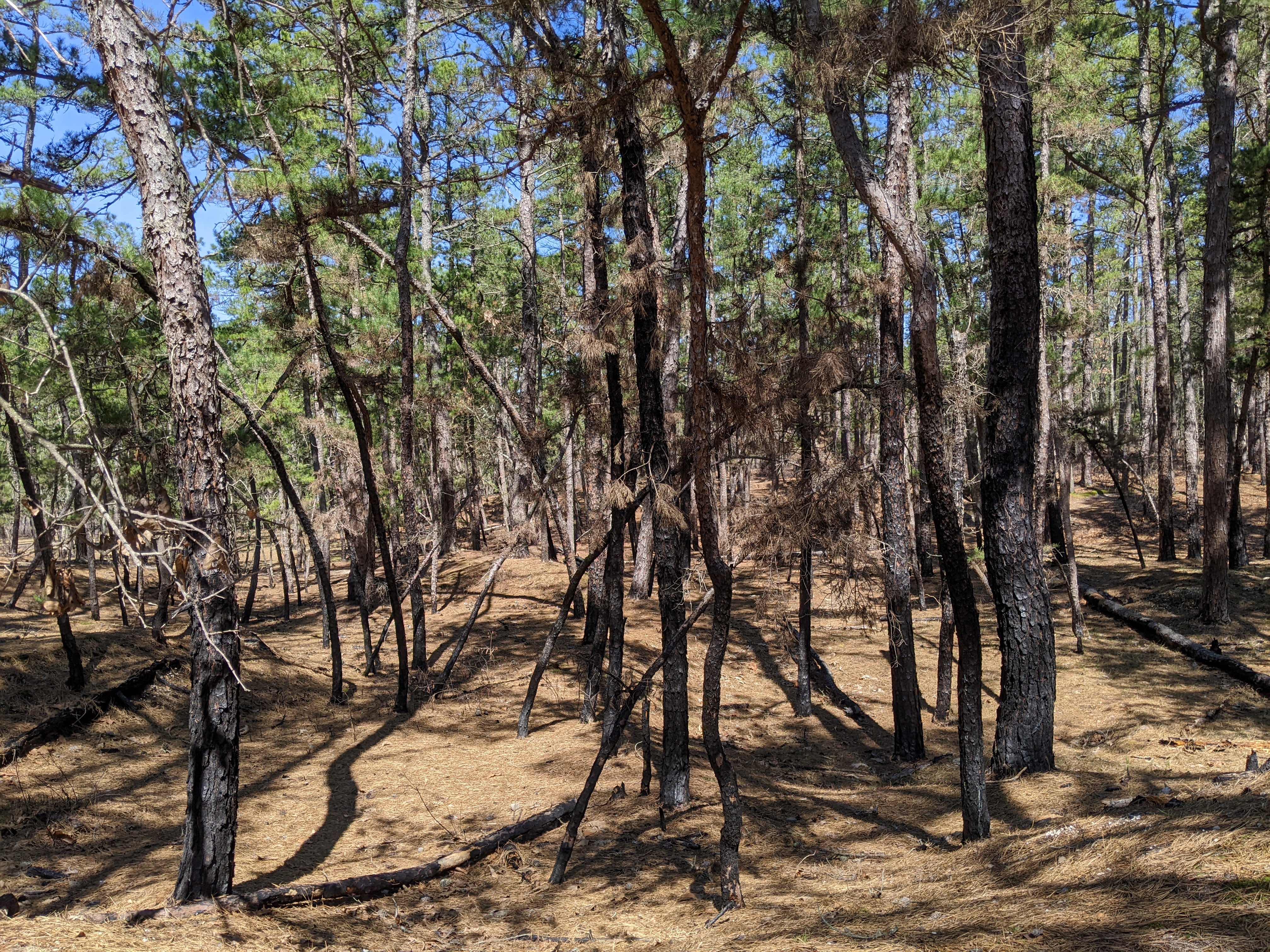
Camping for Easter weekend with two teens in the New Jersey Pine Barrens held special significance for us as we continue to work through the loss of a beloved family member back in September. As we tick off first holidays without their Poppy, the kids seemed excited to find new ways to think about loss. Spending time in nature can certainly help.  On our Easter campout, it seemed fitting to reflect on themes of death and resurrection, loss and rebirth, while hiking through last year's big burn area in Wharton State Forest. 


Last year's wildfire season was already in full swing when in June, 2022, Father's Day Weekend, an illegal campfire - unattended and whipped up by afternoon winds - caused the  biggest blaze in 15 years, the 17th largest since fire history of the Pinelands has been kept. It spread across portions of several townships, through the Wharton State Forest, and along the Mullica River. Backpackers and campers were evacuated from the Batona Trails, surrounding recreation areas, and backcountry campsites. The fire cost nearly one million dollars to fight. Certainly not a prescribed burn, these are the kinds of fires the Pinelands see more of as fire season expands to nearly year-round. 


                                        . 


We walked through a blackened forest carpeted in thick layers of crispy needles of Pitch Pine, yet everywhere - on charred trunks and from the ground - sprung fresh needles of saplings and shoots. The teens, never having witnessed a recent burn like this, were speechless as, mile after mile, it seemed a new forest was emerging from the old. Pine cones lay open, some eaten by squirrels, others having lost their seeds to the forest char and duff. Pitch Pines are fire dependent and this is just what those closed up cones needed to force their opening. But we were aware of the intensity of this fire that nearly captured the crown and spread so fast that people just escaped with their lives. 


Up from the duff and ashes sprang Low Bush and High Bush blueberries alongside fresh green shoots of Sheep Laurel and Leatherleaf. We gawked and giggled past impossibly green mats of new Bearberry with their blossoms of pink and white tended to by Bumble Bees and Miner Bees. We watched ground nesting Miner Bees emerging and returning to exposed sand beds. "Whoa!!" they laughed as a parade of tiny bees flew in and out of a hundred sand tunnel entrances. 


Sand myrtle, Kalmia buxifolium


Trailing arbutus, Epigaea repens


Leatherleaf, Chamaedaphne calyculata


The trail turned towards the Mullica River and soon we saw an Osprey, another Rite of Spring. (Thank you, Rachel)  Every log was crowded with Eastern Painted Turtles and a big American Snapper hung motionless with her mossy green shell just breaking the water, her head and snout pointed at us, looking. A Yellow Warbler flitted from the branches of a White Cedar while a flock of Pine Warblers chatted it up in the tops of the highest pines. Even with the black ash and charred trees all around us, spring seemed unusually colorful and surprisingly joyful in the pines. How could we not giggle? 


An unburnt section near the river


Admiring the Mullica and its many turtles


In the Pine Barrens 

The pines here are incendiaries: not
      content to wait for conflagration,

they brim themselves with pitch,
        living torches spoiling to be lit, 

dry needles kindling on the sandy soil,
        cones hard, uncrackable except

by fire, seeds dormant till released by flames,
        to fall unchallenged on the flame-cleared

ground. The trees don’t mind being scorched,
        as long as the barrens can be swiftly

re-sown by their progeny, hardy, reckless, fully
        as combustible as themselves.


From the collection Nine-Bend Bridge (2018)
Winifred Hughes


Sand road (and fire break)


Fireproof Pitch Pine


New forest beneath the old, Pitch Pine, Pinus rigida


We found a patch of freshly emerged Bayberry and picked one leaf to crush and breathe in its intoxicating scent, an important medicinal plant for Lenni Lenape and pinewoods doctors like James Sill, brother of Underground Railroad Founder, William Sill. I found a remedy of Dr. Sill's, who described the oils of Bayberry as a curative for sore feet and legs, "when bathed in warm water with ashes added to aid in circulation. It has an astonishing effect."  Off they went, almost at a jog to finish our hike, revived by the Bayberry and the promise of a food truck at Batsto Village that offered real Italian ice. 


Northern Bayberry, Morella pennsyvanicus

Notes: 

James Sill ( 1877) Early Recollections and Life of Dr. James Still. Forgotten Books, Middletown, Delaware. 


Tuesday, March 7, 2023

Emergence: An Apology

 I wanted to apologize to all the readers of my blog for my disappearance and lack of posting anything at all about the natural and unnatural, even supernatural, encounters with Mid-Atlantic environments. I've been overwhelmed with life, and while the holidays hit particularly hard this year, I stopped writing, exploring, and researching pretty much since then. 


I tried to retire but I failed spectacularly at it. I discovered I am not built to navigate the retired life successfully but I did not want to go back to the crazy-making life of toxic work culture. I discovered that being bored is just as toxic. Not even long walks in the woods helped. 


Still processing the loss of beloved family members, and the immensity of the empty spaces they leave behind, I took time to think and pray and remember. Months of  time. The loss of my spiritual director, a beloved elder Franciscan contemplative from the mountains of central PA, made the emptiness profoundly unbearable. I took on a new full time job. I went back to teaching as well. 


All this to say that I just couldn't throw things into this blog for the sake of having it take up content space. It was best to give it a rest, too. Mid-Atlantic "nature" is complex and rooted deeply in our history. It needs to be experienced in a way that calls for our presence and reflection and honest assessment of what is natural and what is not and why it matters. 


My sister and I recently talked about ancestors and memory and why someday we may move back to the mountains that contain our childhoods and family stories and all the familiar places that raised generations of Scots-Irish immigrants and their offspring. I have distinct memories of those people who raised me and even of ancestors I never met but who were important in how we related to our environment and each other. Lots to contemplate when faced, too, with the loss of landscapes forever changed by "progress" or climate change or neglect or ignorance. 


I wasn't surprised the other day to find that I was fly-casting next to a Franciscan brother, up from seminary to enjoy some outdoor time. Who better to fly fish with than a monk?  I asked him about sorrow and nature and whether he was using nymphs or flies. It was just conversation I needed and it  made me remember readers who have been in the dark about what happened to me. Brother Mike said that we all need time in the dark, nymph-like, to contemplate our emergence. We were both using nymphs. 


So that's it. My list of excuses and reasons not to have gotten out in this winter of no winter. Thanks for understanding that my absence here is by no means an abandonment but a reconsideration of the purposes of this blog and the time and care it takes to keep it going. Maybe a book would be better? Maybe some essays or poems? An academic paper? We'll see. I'll keep you posted. 


Friday, January 6, 2023

PA Pinnacle Trails: Fogbound

 #52  2022 52-Hike Challenge: Pinnacle Overlook and Woods Trail Mix - 2.5 miles

Still trying to get caught up on 2022, here is my last hike of the year on December 31, a full six months past when my competitive cousin finished her 52-Hike Challenge in July then went on to hike an additional 20 hikes to equal her years in age. 


Not Hadrian's Wall


When I texted her to let her know I'd finally reached 52 hikes on the last day of the year, she proudly told me her total mileage, average pace, longest, shortest, hardest, and (best of all) which hikes included a stop at a local pub. In England and Scotland, it's not hard to find a brew stop right on a major hiking trail. So, in the spirit of good sportsmanship, I conceded and congratulated her, as I climbed the last hill of the year in a thick cloud of fog. 


Where's the pub?


Where there should have been amazing views of the Susquehanna, there was only fog. It crept through the woods like a blanket being pulled slowly over the hill. It swallowed up the trail so that I could only see one blaze ahead. I missed a critical intersection and wandered too long on the Conestoga Trail the wrong way before I noticed I was following orange blazes and not red. 


Delicate Fern Moss, Thuidium delicatulum 

This old familiar ground seemed a little feral today, like something wild and unexpected could jump out of the mist and give chase. Likewise, the sodden ground is thick with fallen tree trunks where there might be something or someone magical watching us pass by from under their fern-thatched rotten log homes. 


The Old Pinnacle Road

Being a little short-sighted due to the fog, I was forced to look close-in, closer-by, for dramatic views of more intimate scale. Colorful lichens and tree jelly fungus added splashes of orange and blue to the drab backdrop. I studied the different shades of brown and grey from the forest floor to the leafless canopy and it reminded me of rough woolen yardage, dyed with natural plant dyes in a vat. 


Jelly Tree Ear Fungus, Auricularia americana

We met one other person wandering around the woods, a little lost like me. Amos sounded his happy whisper yelp and wagged his trail as the other hiker asked how far the Conestoga Trail goes north and how, in a mistaken right turn when he should have turned left, he hiked the hardest three miles he'd done all year. I assured him I did the same, though not as far.  The fog seemed to mess with our sense of direction.


Summit at Pinnacle

I walked out to several viewing points over the Susquehanna, thinking wrongly that here I would find a break in the dense fog. Tundra Swans flew low overhead and I could hear the wind through their flight feathers, zip-zip-zip. Their staccato calls drifted downriver, following this major migratory flyway that connects arctic waterfowl to their winter refuge on the Chesapeake. I imagined they were keeping close by sound so their tight flight lines didn't unravel in the blinding mist.


Last year's Indigo Bunting nest 


Close in were the elegant remains of last nesting season: a Cardinal nest tightly wound about with strips of grass and pine needles, a stacked mud hut with an open view of the sky built by an industrious American Robin, a delicately woven teacup attached to a forked branch assembled by an Indigo Bunting to impress his mate, adorned of course with a strip of plastic wrapper.


Downhill towards Kelly's Run

I looped around the hill on the old roads and listened to Kelly's Run whooshing down the ravine below. All around were ghostly forms of old trees and the fading remains of 19th century farm lanes and wagon roads. On this hill there were no grand historic ruins except for long undulating stone fences and reclaimed farmlands reverting back to forest, which, in its own way is a big testament to the persistence of nature.


Turkey Tail, Trametes versicolor


Start and end of the last hike of 2022

Somehow we found ourselves back at the truck at the end of the last hike of 2022. I had to think some more about whether to join my cousin in another challenge. This year seemed frustratingly rough to hike with any regularity. So many changes in my life, so many adjustments made, and at times the joy of hiking was hard to find. I was so exhausted this fall that it almost seemed like a chore. In the end though I did agree to take up the 2023 52-Hike Challenge but this time I gave myself a little advantage by proposing a 25-Hike/25-Ride +2 Your Choice adventures. In a final text of the 2022 Challenge she agreed to give it a go. "You know I don't ride bikes," she typed. "But I guess I'll have to get back into it." Challenge accepted and here's hoping the fog will lift. 

Saturday, December 31, 2022

PA Enola Low Grade Trail: Night Hike

 #51  2022 52-Hike Challenge: Enola Low Grade Rail Trail Night Hike: 5 miles

Every river is a character, a living, breathing being. Some say they have spirits or souls. Some say rivers should have rights and be treated as people, as a nation of living things. All I know is that the Susquehanna will let you know who she is and how she wants to be treated. She is a Grandmother, an elder among rivers, one of the oldest rivers on the continent. A survivor of glacial floods, rising mountain ranges, and the insults of industrial man. The best time to meet with her is at night and listen for her advice. 


Susquehanna River at Safe Harbor Dam, 12-30-2022, sunset.

Ever since the completion of the enormous trestle bridge at Safe Harbor Dam over the mouth of the Conestoga River this year, this section of the 30-mile long Enola Low Grade Rail Trail has become a favorite for night bikes rides and evening strolls. The sunsets can attract crowds and many linger well after last light fades. Looking down at the confluence of these two historic rivers is mesmerizing in the dark. The creature sounds from the islands, eagles, gulls, herons can be heard above the rapids and deep swirling eddy pools below the dam. Clouds of gulls circle the outflow. Eagles sit on boulders in pairs. Courtships have begun.


Last light of the last sunset of 2022

I walk with Amos a five mile out and back north from the trestle bridge, past the Peregrine cliff. In a few months she and her mate will be back and the "Warning!" signs will go up again not to stop or stand too long below the eyrie.  A few unlucky walkers and bike riders this past year can tell you why. The river above the dam is a solid mass of ice and it pops, groans, and cracks like a rifle. It's here below the scrape of a nest that I send a little prayer of thanks to one of my heroes, Rachel Carson. In her time and to her alarm, many of the great birds of prey found on this river were nearly gone from exposure to toxic chemicals dumped, leached, or leaked into the Susquehanna. Now they are all back, breeding, recovering - Bald Eagles, Peregrine Falcons, Osprey.


Peregrine Cliff

Dams are still an issue, even as I admire Safe Harbor Dam, an antique yet elegant hydro-plant that stands iconic, even beautiful in the night. I will never forget the hospitality and wonderful evening I spent here with plant staff who held a pizza party in honor of our headwaters-to-mouth paddle to the Chesapeake. We were cold and soaking wet from a downpour that lasted hours. Our two canoes had gallons of water sloshing around in them from the rain. Everything froze on contact. It was late winter, early spring. The river was running hard, wide, fast, ice-filled. The dam minders came and got us at the take-out and drove us in their big truck to the park to pitch our tents under the pavilion. They came back to get us an hour later. "Come get hot showers. We've got pizza, too!" It was the most wonderful night of our month on the river. I say a little prayer of thanks to them, even thirty years on wherever they might be now.  I pray, too, that someday the fish will pass by here again. Restore the Shad, Eel, Sturgeon, and all the Fish Nation that for millennia came home to this river from the Atlantic to spawn, I say out loud. 


Safe Harbor Dam


A line of night riders approaches, blinking white lights from handle bars and steady beams of helmet headlamps twinkling down trail. My headlamp is lit as well and they slow down as they get close. "The best time to be out here!" one calls to  me, and I agree! Amos gives them his famous "whisper howl" and wags his tail. We make it to the two-mile marker and turn around to head back to the trestle bridge. Another lone biker comes up from behind and rings her bell. "Enjoy your evening walk! Can you believe how beautiful it is tonight?" she calls as she rolls by. I say a little prayer of thanks to the people who made this trail possible. It has been a blessing to the communities who have benefited from all  the new visitors (some who come from far away) who stop for a coffee, lunch, or a B&B, who call for a shuttle (I did four transports this year!), and visit the villages and towns.  


Our distance tonight


As we come back across the trestle bridge it is almost completely dark except for the light the half moon provides and the last light of the day that tints the western sky.  I think about the family and friends we've lost this year and how I wanted so badly to get Poppy up here on the trestle because he loved big views, trains, rivers, but both its immediate inaccessibility (steep stairs from the parking area below) and his rapid decline from Parkinson's this summer made it impossible. He was an avid reader of this blog and loved to look at all the pictures I took after every adventure, every hike, paddle, bike ride. His leaving this year has put a heavy hurt into this family.  I say a prayer for him and his family who miss him so much. I say a prayer to all the caregivers of people with Parkinson's. It is truly God's work and there are angels among them. 


Nightfall 2022


I stood awhile at the rail of the bridge and asked the river "Where to now?" and waited for an answer. A fox screamed from the hillside. The river is hungry and is making its fast way around boulders and snags caught on gravel banks. The big smooth rocks that hold the petroglyphs shimmer under the moon. The river makes a game of dragging slabs of ice across the gravel edges of the rookery island. The ice screeches and a Bald Eagle cackles. Water domes up from deep currents and the eddyline marks the Conestoga meeting the Susquehanna burbles and sings. "Onward," says the river. "Don't stop moving. Keep going. Make a good song as you go." And strange as it seems, I hear distant voices and people singing and music. I first I think it is coming from a car way down there in the park, but the sound is coming from the islands and there is no light to see by. No fires. No beams of light. Then it fades and is gone. 

Sunset...


Goodnight, 2022. I say a prayer for you, dear reader, that 2023 is full of discoveries, laughter, music, and light. May all your endings be new beginnings on new journeys. God bless dogs!

Above the mountains
the geese turn into
the light again

Painting their
black silhouettes
on an open sky.

Sometimes everything
has to be
inscribed across
the heavens

so you can find
the one line
already written
inside you.

Sometimes it takes
a great sky
to find that

first, bright
and indescribable
wedge of freedom
in your own heart.

Sometimes with
the bones of the black
sticks left when the fire
has gone out

someone has written
something new
in the ashes of your life.

You are not leaving.
Even as the light fades quickly now,
you are arriving.

- David Whyte, The Journey


Happy Trails!


Friday, December 30, 2022

PA Kelly's Run: Turn Around, Don't Fall Down

 #50 2022 52-Hike Challenge: Kelly's Run Nature Preserve: Alternate Loop/ 2.5 mi

Last week's flash freeze certainly did a number on some of our local trails, so much so that even in 50-degree weather hiking the deeper ravine trails can be treacherous.  I've tried this loop six times in winter over the years and only twice have I actually completed all four miles around, both times wearing micro-spikes. All the other times I simply turned around when I encountered dangerous ice and did alternate trails rather than risk a bad fall. Today was one of those turn around days. It was also a bad fall day.


No matter how bright and sunny up top, prepare for ice below.


Conestoga Trail pole

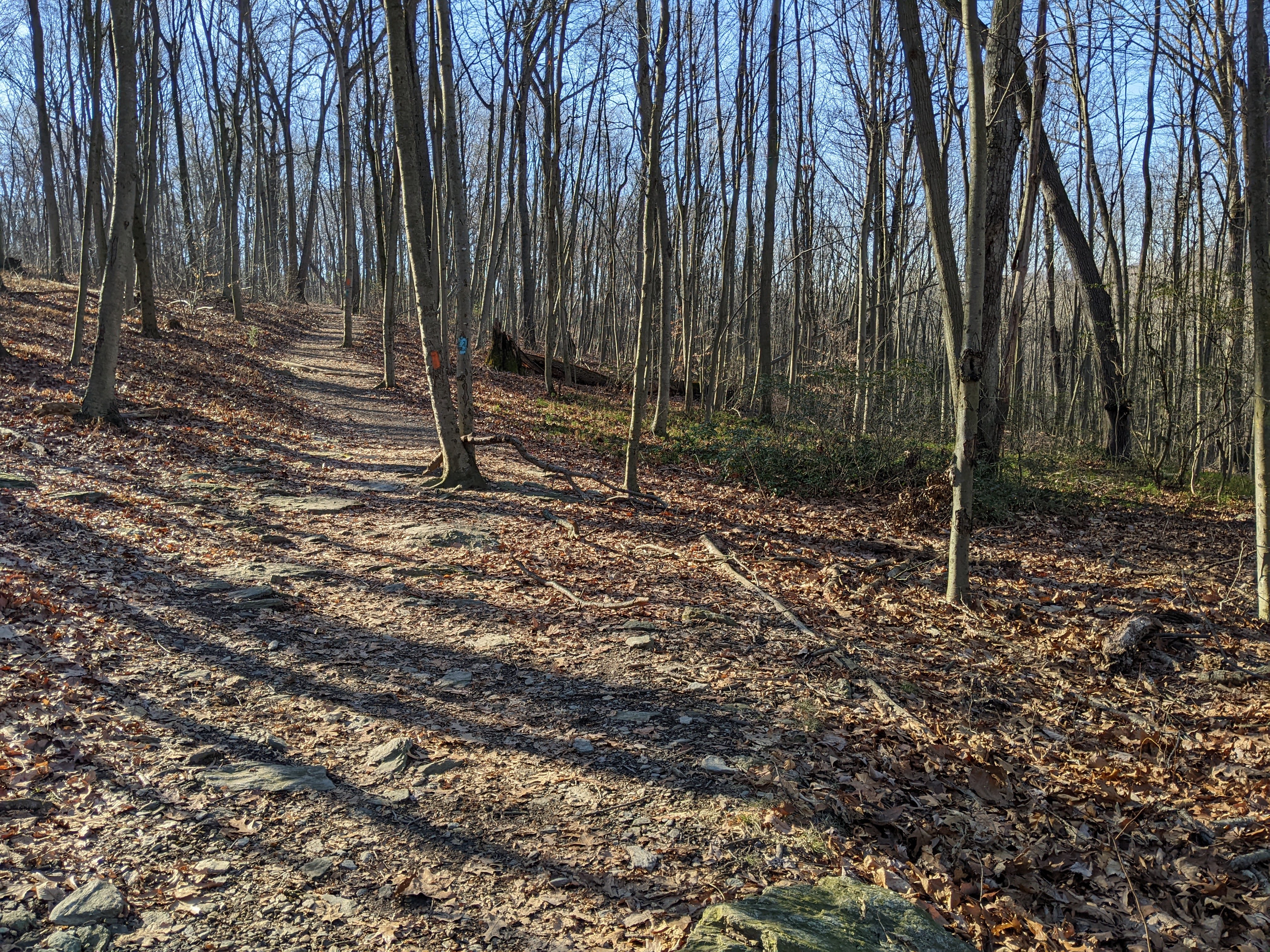
The main section of the Kellys Run loop trail  is also a section of the Conestoga Trail, so hikers will see both orange and blue blazes as they go from the bright sunny meadow on top of the hill into the shadow-filled and cold ravine below.  I knew there was a good chance that I would encounter dangerous ice, so I planned ahead of time to backtrack and loop around on the red blazed connector trail and return through the warm, sunny woods. But even before the descent began, the trail was icy-covered or deep mud. 


Frozen trail 

We wandered down the hill past charcoal hearths and across slab-rock slopes, through mature Chestnut Oak forest and down into the dense rhododendron. Amos was picking his way carefully and a few times he whined with concern. Listen to the dog. He's done this trail enough in winter to know what comes next and he seemed hesitant to begin the steep descent towards the stream.  He does not like ice. 


Common Haircap Moss, Polytrichum commune

As we neared the first stream crossing, crowded in by a narrow trail against a massive rock wall, we stood aside as a large hiking group of 15-20 people passed us coming up from the ravine. They all looked a little weary.  Several folks stopped to pet Amos and ask about the trail further up. I told them that for the most part it was clear of ice and they seemed relieved. Just then I heard the trip leader call "Turn around!" and people looked a little confused. As he came past me again on his return, I told the trip leader about the red blazed connector on the hill that leads to the old Holtwood Road section. I said that if he needed a safer way to loop around without having to do the icy ravine twice, it might only add a mile and a half to their loop from the Pinnacle where they were parked.  He assured me he knew all about the trails here and soon the group was headed back into the ravine.  Amos and I followed very slowly down into the high-walled canyon behind the big group. I had a bad feeling about this. 


Traffic jam as an injured hiker is tended to 

Sure enough, the whole group came to a stop at the first treacherous crossing as a hiker had fallen hard and hurt her ankle and leg.  Amos and I lingered in the creek - me studying moss and he taking a refreshing drink. The  group stood around as the trip leader assessed the situation and the injury. I asked the folks in the back of the group if I could help in anyway  as I carry a full kit with elastic wraps and a wire mesh splint, but they thought everything was being taken care of. That was my turn around. 


Heading back up

The thing about these ravine trails is when they become ice covered they tend to stay that way even through warm stretches. The ice melts a little during the day then refreezes and glazes over at night. The ravine is always shady and cold. Leaves and mud soon cover the icy sections and this tricks the unwary hiker into thinking the trail is solid and safe. Even when the stream is running ice-free, the trail can be tricky, especially steps and inclines that are muddy and skim-iced.  Other people came up from the ravine having passed the large group still in the ravine. They said the further down the worse it was getting as the daylight was waning, and that the injured hiker was still being treated. 


Happy Amos on a warm, ice-free trail

I hate second guessing any group leader but as I hiked back up the steep rocky pitch to the red blazed connector trail (and the warm dry woods) my "situation debrief mode" went into full drive. If a safer alternative to a dangerous section of trail is available, even if it adds a mile or two - or an hour or two - to the hike, wouldn't that have been the wiser thing to do? There should always be an emergency bail out or alternative trail on any hike and more than just the leader should know about it. In addition, if a sudden change in plans like "Turn around!" is called, it should be the decision of a leadership team to make, not just one person's decision, especially for such a large group.


Orange and Blue

We arrived back at the parking area safe and sound but I had to turn my brain off as I was going through so many scenarios in my head that I completely forgot to enjoy the trail as Amos had enjoyed it - warm and dry and peaceful.  He was soon fast asleep on the back seat without a care in the world. I hope the injured hiker is okay and that the group was able to navigate again the treacherous ravine trail and return safely.


Notes:

Kellys Run Nature Preserve is popular and beautiful any time of year, but needs to be given an extra ounce of caution when hiking the ravine section in winter or in flood/high water. Plan for alternatives or turn arounds in icy conditions!  https://www.lancasterconservancy.org/preserves/kellys-run/