The heat of summer has settled in. Meteorologists call it a heat dome. Nothing moves in the humid air. The woods are quiet. The birding world calls this time of year the doldrums in the Mid-Atlantic, a silent time that occupies the space between the excitement of breeding and nesting and the spectacular fall migration. But on today's hike, a slow walk for which I did not cover many miles, but did indeed cover a lot of ground, I discovered a lot of activity - just not as obvious as spring and fall.
 |
| Gifford Pinchot State Park HQ and map rack. |
I decided to head to Gifford Pinchot State Park, named for the first head of the U.S. Forest Service under Teddy Roosevelt and who also served as Governor of Pennsylvania in the 1920s. He was one of the New Conservationists in his years as governor, a group of state and national conservation leaders who worked to transform exploited landscapes with environmental restoration. In Pennsylvania, some of these enormous projects encompassed entire watersheds and created numerous state parks and forests with conservation work crews that predated the CCC. Pinchot's legacy includes tens of thousands of acres of protected forest, wetland, river, and marsh.
 |
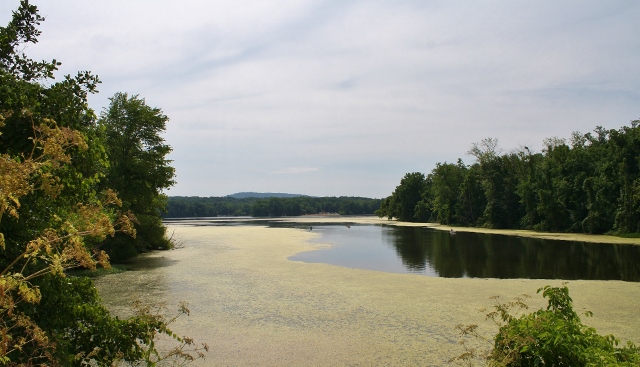
| Pinchot Lake under high heat and algal bloom. |
Under the heat dome, we've experienced almost a week of triple digit temperatures. Walking along the Lakeside Trail to reach the headwaters of Lake Pinchot I could smell the dank scent of algal bloom. Excess nutrients, high water temperature, intense summer light, and minimal disturbance are the key factors that cause the blooms. The blooms can cause severe oxygen depletion in bodies of still water like lakes and ponds, and though not all of Pinchot Lake was under the blanket of this bloom, sheltered coves and areas where wind and boat traffic do not stir up the water suffer the most. For wading birds like herons and egrets, algal blooms mask the waters below. Fishing is better along lake shores where waders can see their prey best, so no waders along upper cove shores today.
 |
| Lakeside Trail leading to Beaver Creek Marsh. |
I stopped frequently along the Lakeside Trail to listen for birds. A small, noisey flock of titmice and chickadees alerted me to a red-shouldered hawk sitting on the water treatment impoundment fence. He was frogging in the still waters, swooping down to snatch a bullfrog from the mud bank. I watched him devour the frog while blue jays and crows joined in the mob. He seemed not to care and flew off unbothered into the deep woods. I stayed on, however, listening and watching. The stillness seemed to hold secrets and I wanted to discover what was happening behind this veil of heat and humidity.
 |
| Froggin' on the impoundment - Red-Shouldered Hawk. |
I considered the woods and all its occupants. I wondered what I would see and hear if I stayed a full twenty-four hours, like a human game camera. The hawk had been a hint. Red-Shouldered Hawks and Barred Owls often occupy the same woods, the hawk hunting the same prey during the day that the owl hunts at night. I tried calling in a Barred Owl, but it was the wrong time, too much the middle of the day for any response. Yellow-billed Cuckoos, however, kwalped and scolded from the interior. My owl call drew the cackling jay-crow mob which escorted me to the end of the trail across from the Beaver Creek Marsh where I picked up the Beaver Creek Trail. The sunny edge was shimmering with flowers and berries!
 |
| The remains of an old cabin site - end of the Lakeside Trail at Beaver Creek Marsh. |
 |
| Blooming at the end of the trail - Black-Eyed Susan. |
 |
| St. Johnswort |
 |
| Red Raspberries! |
Sitting still is an important skill for truly appreciating and learning about nature. Though a few people hurried past my sitting post on the Lakeside Trail, no one saw me, just yards off the path leaning against a comfortable tree. Noting the spot for future observations, I continued on, considering the importance of stillness and quiet, of becoming part of the landscape in which one dwells.
Sometimes
Sometimes, when a bird cries out,
Or the wind sweeps through a tree,
Or a dog howls in a far off farm,
I hold still and listen a long time.
My soul turns and goes back to the place
Where, a thousand forgotten years ago,
The bird and the blowing wind
Were like me, and were my brothers.
My soul turns into a tree,
And an animal, and a cloud bank.
Then changed and odd it comes home
And asks me questions. What should I reply?
- Rainer Maria Rilke
Crossing the road to the Beaver Creek Marsh I observed an Eastern Kingbird hunting over a protected nursery for wetland plants. Kayakers were putting in at the boat launch hoping to get to the lake before a line of storms and showers rumbled through. I hurried to the Beaver Creek Trail entrance as low roll of thunder echoed across the hills. Answering the thunder was a deep-throated chorus of bullfrogs and a flurry of dragonflies hunting the edge of the shimmering marsh.
 |
| Eastern Kingbird hunting from a netted enclosure pole. |
 |
| Halloween Pennants mating in the marsh. |
I stopped again, just inside the trail under the shelter of red maples. For a long time I stood and watched dragonflies diving, chasing, and swooping. The skies piled high with thunderclouds. Cardinals chipped from the trees, annoyed at my presence. Another Red-Shouldered Hawk dashed through the canopy with a complement of crows following closely behind. So far, this hike was anything but the doldrums! Even the kayakers were interesting as they explored the marsh - only their heads and circling tips of their double bladed paddles were visible above the expanse of pickerel weed.
 |
| A small feeder stream empties into the marsh - a nice listening spot. |
 |
| Widow Skimmer. |
 |
| Pickerel weed marsh at the mouth of Beaver Creek. |
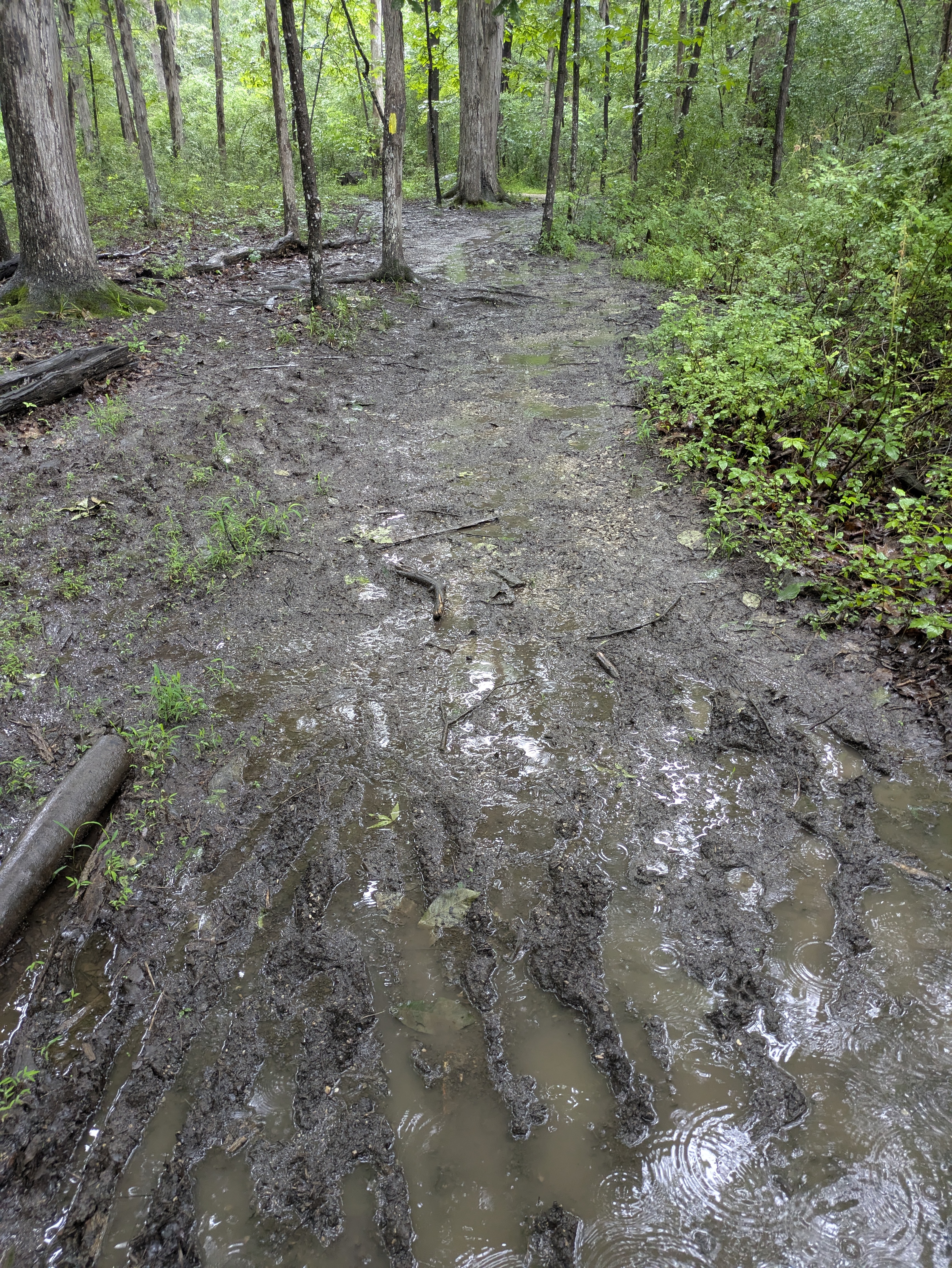
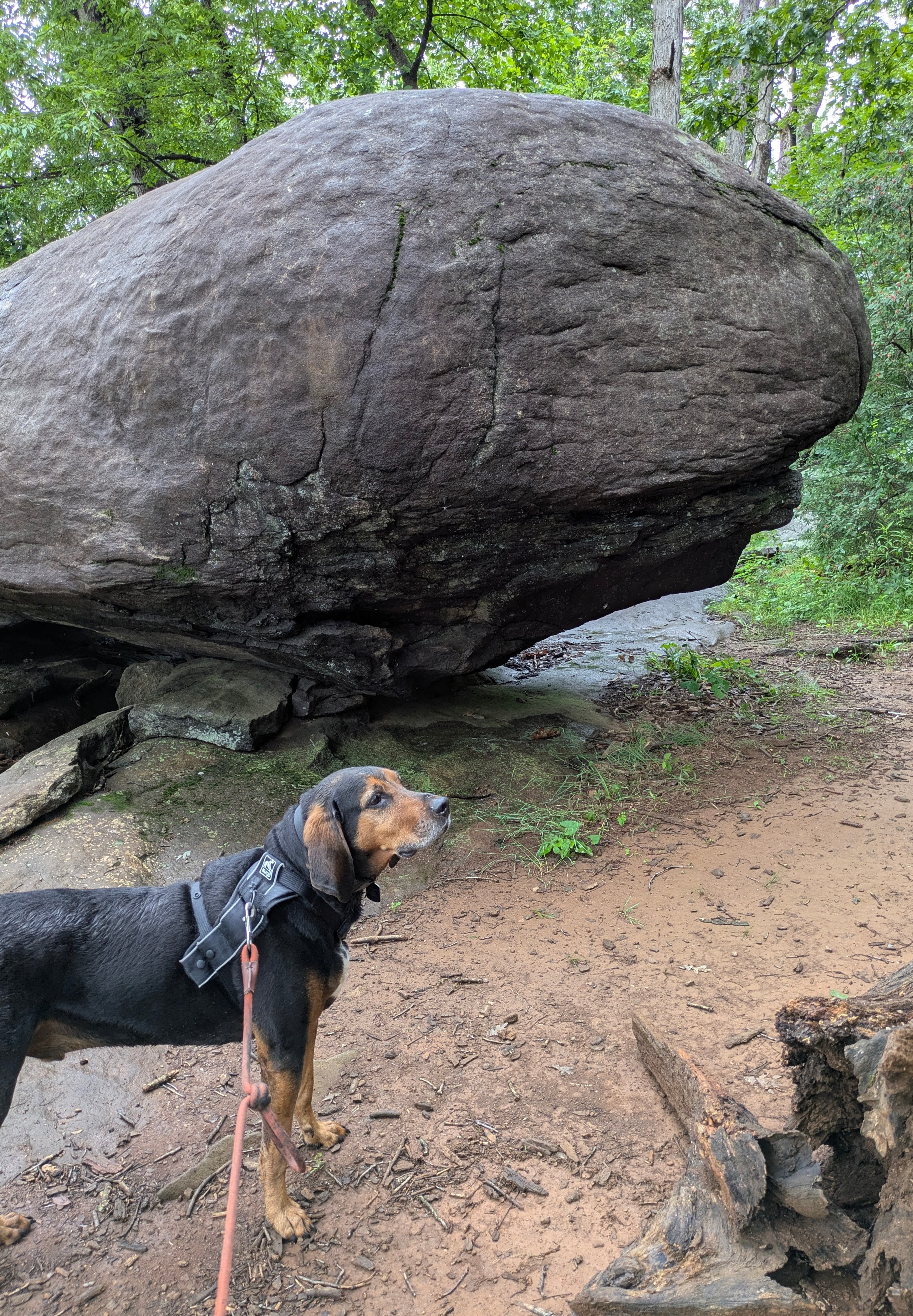
The line of storms built and billowed overhead, slowly moving east, and the sun soon appeared again. I moved deeper into the woods following the trail, now rocky with exposed frost-shatter boulders that hinted at the field of stone hidden below the surface of the bottomland woods. Frost-shatter boulder fields such as this tell a story of sub-arctic climate as the great glaciers receded to the north. Thirty thousand years ago this was a much different landscape, brutally cold and dry. As the climate warmed in central Pennsylvania, the rains came. Forests and swamps dominated the valley for ten thousand years. Streams and rivers washed away the thin topsoils and detritus to reveal the frost-shatter fields of cobble underlying creek beds. The trail became a combination of boardwalk and cobble-hopping. I found another nice place to stop and listen at a story stone embraced by the roots of an oak. Red-Eyed Vireos and American Redstarts filled the woods with calls and soft songs.
 |
| Summer dry, these low woods are submerged in spring snow-melt and often flood in autumn rains. |
 |
| Frost-shatter cobbles smoothed by running water, now seasonal. |
 |
| American Redstart snatching an insect in the canopy. |
 |
| Story stone - a stone embraced by or embedded in a tree. |
Story stones are placed by other naturalists to mark a place of interest for future visits. When I was a park ranger I would place cobbles of white quartz on stone walls or at the base of huge trees to mark locations that held biological or cultural meaning. When I led walks and hikes with groups, the stones reminded me of what I wanted to share. This stone was placed in the rooted arms of a tree, a marker for the park's naturalist to gather her families on a sitting log off trail at the edge of the marsh. It was a wonderful place to watch dragonflies, but hard to spot if you didn't know where to leave the trail.
 |
| Tiny, delicate tick-trefoil. |
As I continued on, the marsh transitioned to Beaver Creek, visible through the trees. Though some kayakers ventured this far, the creek was nothing more than a narrow band of slow moving water clogged now and then with tangles of vine and fallen limbs. Beyond the reach of paddlers, I found another nice stop at a point on the trail where the creek rounded a bend and disappeared into a thicket of brush. Sitting on a clear patch of creek bank, I attracted the attention of a band of young robins, cautious catbirds, and the familiar mob of titmice and chickadees. I was roundly scolded for a few minutes, but soon forgotten as fledglings harassed their parents for food. Redstart males chased each other through the thicket and somewhere from deep forest, a wood thrush fluted.
 |
| Beaver Creek moving slowly through the woods. |
 |
| Last of the jewelweed. |
 |
| Female Widow Skimmer. |
I sat a long time on the bank of the creek. Though the humidity was oppressive for me, it seemed to make no difference to the animals and insects around me. A beaver cruised by. Another Red-Shouldered Hawk swept through the forest. The canopy was alive with chirps and songs, though much quieter than one would hear in the spring. I began to listen intently to the quiet calls, interrupted loudly by a Yellow-Billed Cuckoo. The closer I listened the more I heard. Some bird calls were at the limit of my hearing, high-pitched whispers and shadow calls. Insects buzzed and sang. A cicada's song rose in the heat.
 |
| White-Eyed Vireo making whisper calls. |
 |
| Wild Ginger. |
In long heat of the afternoon I closed my eyes and listened to the drone of insects and the whispers of birds. Somewhere over my head a beetle chewed bark that sent a tiny shower of sawdust down through the moist air. A distant rumble of thunder coaxed me out of my comfy sit and I started back down the trail for home. As I walked under darkening skies, the woods took on a glow of gold and shimmer. A lone hiker, plugged in to his iPhone and singing loudly, stumbled past me, oblivious to his surroundings. What has become of natural history, I wondered, when the satisfaction of learning about the natural world was reward enough for the effort of a walk through the woods?
Notes: