Showing posts with label PA Enola Low Grade Railroad. Show all posts

Saturday, June 11, 2022

PA Enola Low Grade Rail Trail and the Rail Trail Phenomenon

The new view from the high Safe Harbor Trestle Bridge over the Conestoga River!

After a decade of major highway building transformed the way America moved freight and people around the country, railroading began a steep decline. Large scale trucking became a more economical way to move goods and materials. More people owned cars and chose to drive instead of taking the train. Railroads were closing unprofitable routes at an alarming pace. I grew up in the 1960s and 70s and remember well last run of the Maryland and Pennsylvania RR, a line that people -especially farmers- had come to depend upon to move their products into Baltimore City. From our little hollow on the Mason Dixon Line, we witnessed the closing of several important local lines. This time marked a bittersweet end to an era but for us kids, it opened a new way to explore our home landscape.
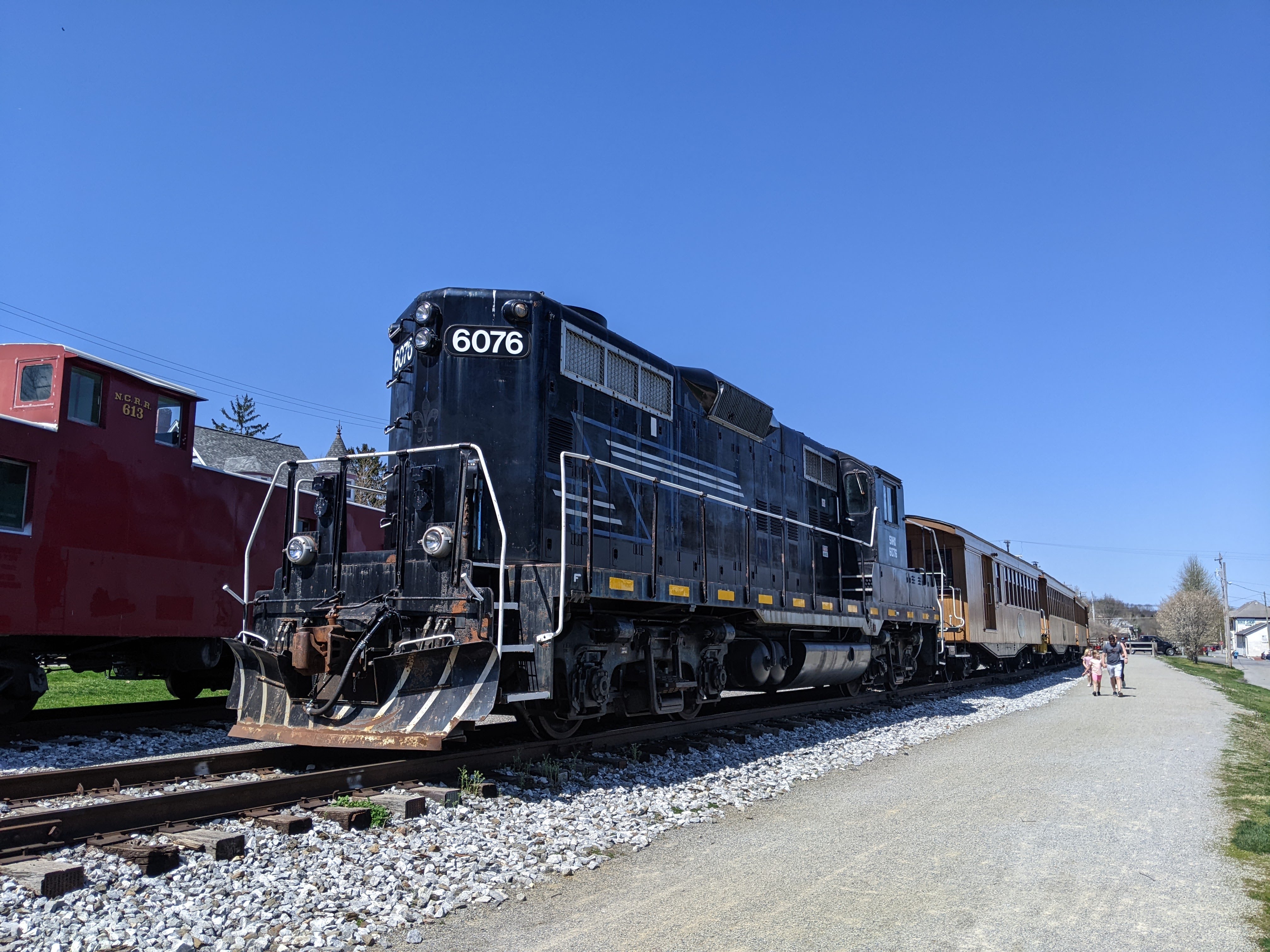
Rail Trail and limited excursion line in New Freedom, PA

People began to use the old railbeds as trails of convenience and for recreation. We certainly did.  There were lots of overgrown miles to ride a bike, a pony, or ramble on foot.  After Congress passed the Staggers Rail Act in 1980 that allowed the abandonment of thousands of miles of railroad to ease some of the suffering of the nation's railroad industry, it also passed an amendment to the National Trails Systems Act in 1983 to "railbank" almost 9,000 miles of disused rail corridors, placing them into preservation-maintenance programs as pedestrian/bike trails. If rail corridors are ever needed again, they can be returned to railroad use. The New Freedom line in York County is a great example of a multi-purpose rail trail and revived (and popular!) limited excursion line. 
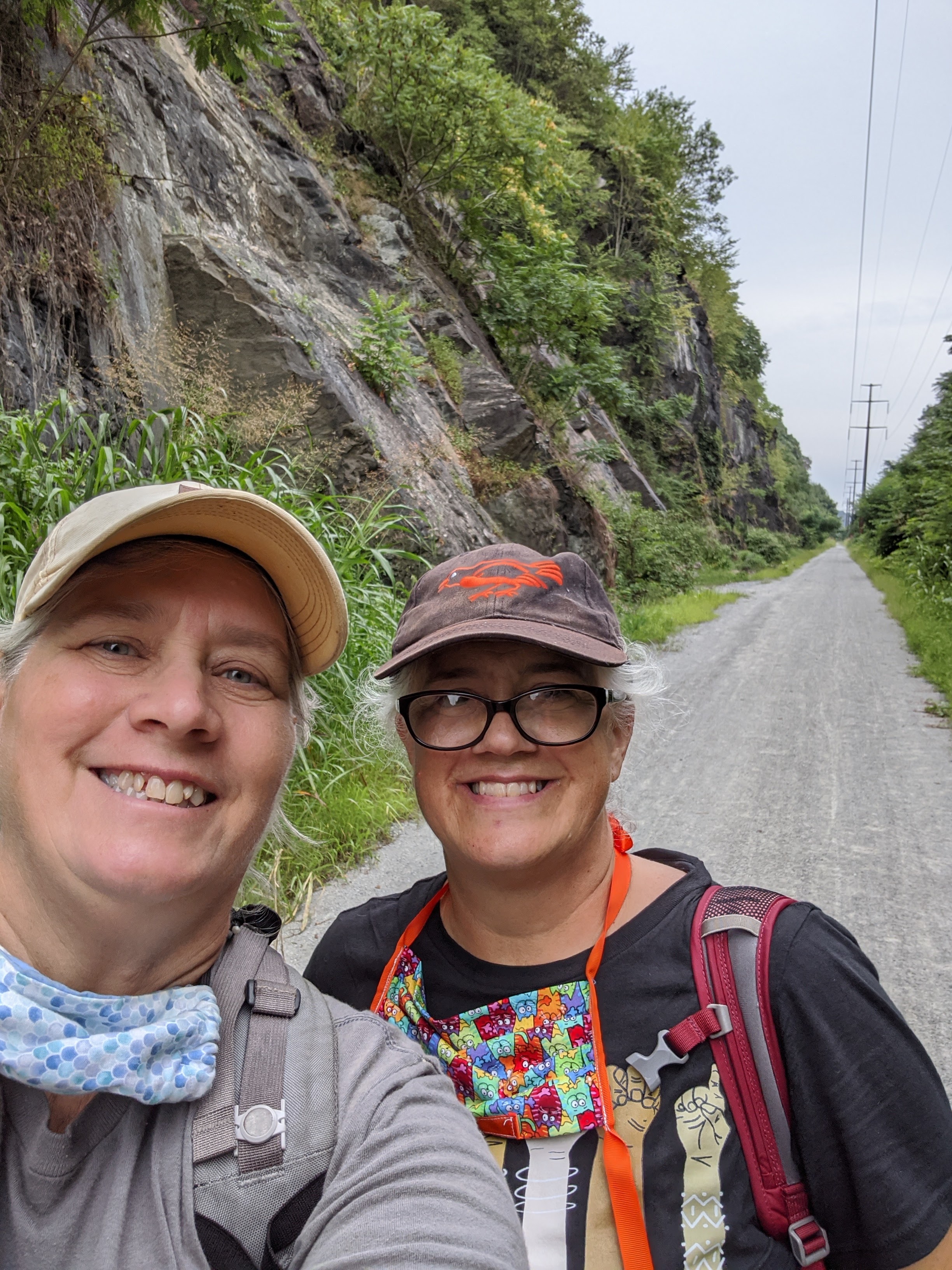

Laura and I walking the ELGRT in 2020 

We've been exploring the Enola Low Grade Rail Trail for many years and since it's only a few miles from home we walk or bike it frequently. It's been fun to watch all the progress along this famously engineered line that runs from Turkey Hill along the Susquehanna to Quarryville in Lancaster county for thirty miles. There are plans to run it from Quarryville all the way to Atglen and Christiana, PA. 
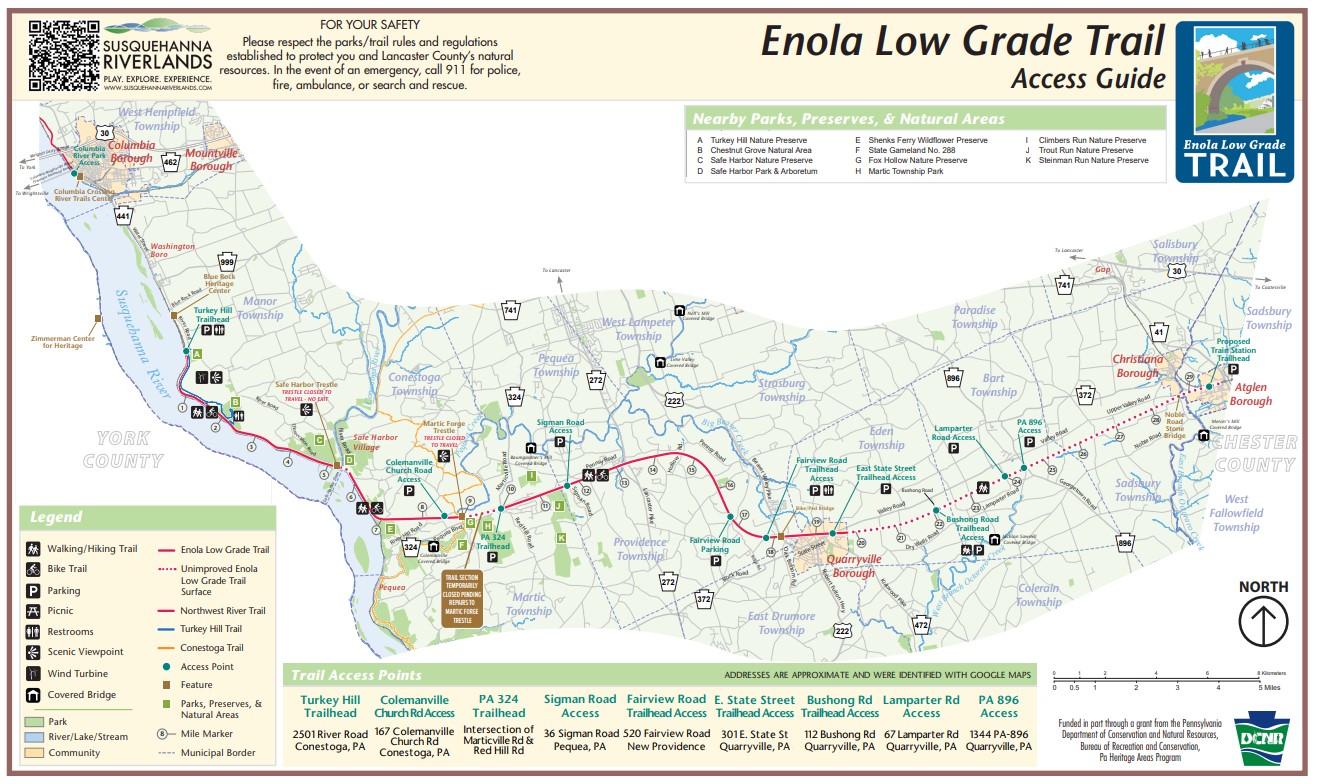


We recently celebrated - along with thousands of our near and distant rail trail friends - the completion of the Safe Harbor Trestle Bridge that provides a much anticipated connection of the Turkey Hill section to the Shenk's Ferry/Coleman Church section and makes possible an almost solid run to Quarryville with one short road section. This fall (2022)  the Martic Forge Trestle Bridge will be completed - again - it was complete until arsonists destroyed it a few years ago, and then the trail will run entirely off road without obstructions or closures.  The Enola Low Grade Rail Trail adds over thirty existing miles to the more to the 25,000 miles of rail trails currently open for public use across the country. 


Opening of the restored Safe Harbor Trestle Bridge 

I arrived on the day after the official dedication and there may have been a tear shed. It was beautiful! The final cost of  $9,000,000 was worth every penny in my humble opinion. I returned on Saturday morning with a small biking group and we ventured down from Colemanville almost three and a half miles to be among the first to cross as the sun rose behind the cliffs. We rode all the way to the Turkey Hill terminus for a seventeen mile round trip. By the time we came back from Turkey Hill, the bridge was super crowded. It really felt like a celebration. So many people, some pushing strollers, one riding a unicycle, some drone pilots, birdwatchers, e-bikers and trikes, gravel bikes, touring bikes, recumbent bikes,  many Amish families, a parade of Scout groups, dog walkers, dogs in bike trailers, dogs riding in handlebar baskets,  all out to enjoy the walk or ride across the new bridge.


Manor Township raised and managed the funding to restore the trestle bridge.

The money needed for the trestle bridge project was raised by the local township using a combination of funding sources. There are many partners for projects like this and a lot of moving parts that include stakeholders who represent federal, state, and local governments.  Funding is secured by stakeholders, including the local townships, through various grant programs and direct giving campaigns. Since old rail corridors and their infrastructure all come under federal railroad regulatory jurisdiction and connects to the federal Recreational Trails Program, most of the funding is sourced at the federal level. Local sponsors and funding partners are critical, however, and the Safe Harbor Trestle Bridge has dozens of placards and sponsorship recognitions along the wooden rails and on kiosks to thank local individuals, organizations, and businesses for helping to match federal funds. 


Pennsylvania Railroad active tracks below

One difficulty of this particular project, mentioned by a riding partner who knows a thing or two about railways, is the active Norfolk and Southern line that parallels the ELGRT downslope along the river's edge. As with many rail trails, active railways still use corridors near recreational trails. These can include passenger services like Amtrack or Metro lines or freight lines like this one. While some negotiations with active rail corridors require special legal and right-of-way expertise, my riding partner explained that the difficulty of such transactions and negotiations is outweighed by the potential economic benefit that alternative transportation projects bring to local communities. In some cases, the benefit can be transformative. He mentioned the fabulous success just upstream along the beautiful Northwest Lancaster Rail Trail that shares some of its corridor with the same active line. Local businesses thrive with traffic generated by walkers and bike riders while the railroad continues to transport heavy freight right alongside with safe access, right-of-way, and careful planning in place for the coexistence of both pedestrians and diesel trains. 


Oak Bottom Road overpass and underpass (further ahead)

Other negotiated spaces include overpass and underpass infrastructure for crossing above or below active vehicle roads. Industrial heartland lines through Philadelphia, Pittsburgh, and Baltimore include hundreds of such crossings where federal funds help design and engineer safe use. The industrial era of the active Enola Low Grade Line is long over and as a rail trail it flies over just a few busy and not-so-busy roads on wooden deck railed bridges. Sometimes I am the only person riding the stretch from Red Hill to Quarryville. I've hiked the rough gravel bed to Atglen and paid for it with sore hips, knees, and painful feet for days afterward. I'll be glad when the crush and run is finally laid there!


Brad & Pam at the new Game Commission peregrine nesting sign with a fantastic river view


For now we celebrate the opening of the Safe Harbor Trestle Bridge, then and now a real engineering feat. Manor Township and other ELGRT communities expect to see upwards of 125,000 visitors a year. The new bridge is considered a new national rail trail treasure and the township, partners, and donors have every reason to be right proud of that. 


Safe Harbor Dam view from the new bridge deck


I guess when we were roaming the abandoned rail beds of the Enola Low Grade, Ma & Pa, and North Central railbeds when we were kids, we were part of the beginning of rails-to-trails phenomenon. I'd like to think we - and a few thousands other kids roaming up and down old weedy grades - helped set in motion a national movement. 


Notes:

Rails-to-Trails Conservancy funding resources https://www.railstotrails.org/build-trails/trail-building-toolbox/funding/acquisition-funding/

Opening announcement for the Safe Harbor Trestle Bridge (!!) Safe Harbor Trestle Dedication and Opening June 2022

Uncharted Lancaster history of the Enola Low Grade An Ambitious and Costly History

The Rails-to-Trails Conservancy https://www.railstotrails.org/

Thursday, April 9, 2020

PA Shenk's Ferry Wildflower Preserve


After a night of thunderstorms that cleared early in the morning I had to get out to visit another one of my favorite local preserves, Shenk's Ferry, managed by the Lancaster Conservancy.  The Conservancy has shut down many of its preserves because of social distancing concerns: crowded trails, damage to natural features, and dangerous parking situations. I decided to investigate this preserve early in the morning, park far away, walk in from another direction, and leave by 10am.


Virginia Bluebells


I parked at the Enola Low Grade Rail Trail Coleman Church parking area neat the Martic Trestle and walked a few miles up to the "back entrance" where a tiny little sign on the rail trail, easy to miss, says "Wildflower Preserve" under the power lines. An almost indistinct path leads down into the woods from there. I was surrounded by a bright green woodland sloping down to the Susquehanna River. This is River Hills country and all around were high banks of wildflowers growing on steep sunlit carpets of new growth.  The Virginia Bluebells seemed to dominate at first, but then enormous carpets of Trillium and Dutchmen's Breeches came into view, spilling down the hillsides, overtaking rocky outcrops, and blanketing the creek valley below.


Susquehanna Trillium, Trillium flexipes

Mayapple and Dutchmen's Breeches

In "normal" times, this preserve is crowded on weekends with masses of wildflower gawkers, including gatherings of Amish and Mennonite who adore the wildflower season along the river. It is not unusual to find more horses and buggies in the parking area than cars! But this year is different.  I met only one small Mennonite family and two wildflower photographers, one whom I recognized and whose last name is the target of his shooting session this morning. See notes.

Virginia Bluebell 

This is river hills walking at its best. This bio-region is found on both sides of the Susquehanna and is a designated hotspot for biodiversity in the Mid-Atlantic. Streams that drain the plateau above the river carve steep valleys that in aerial view form green canyons that branch from the river like root systems from a grand old tree. If you do a "fly over" using Google maps in satellite view you'll see what I mean. It's a landscape too steep for farming and too rocky for building and, except for the remnants of old wagon roads carved into the sides of the hills to reach the fertile farmland above the river, these hill-and-ravine sites are interlaced with trails and are for the most part now protected.

Spicebush "in green flame" as tiny leaves emerge above the small yellow flower clusters

The preserve trail empties out on to the old bumpy Green Hill Road, now closed to vehicles since 2019. I remember when we would drive that old road, nearly getting tossed out of our open bed pick up truck as the truck climbed over the steep ledges of schist in low gear. Now it's a traffic-free walk and from the trailhead paring area to the kiosk at the bottom of the valley and beyond. The old road gives plenty of space to spread out (social distancing!) while the narrow preserve trail is trickier. Jim was sticking just to the road for that very reason.


Ore seam draped in wildflowers. 

What is not evident unless you are looking specifically past  the hillsides of wildflowers at the landscape, is that this valley was once the location of a thriving riverside community, Shenk's Ferry. The 19th century town once contained an iron forge, taverns, two hotels, the ferry station, two grist mills, and dozens of homes along Green Hill Road.


Main preserve trail is actually the C.B. Grubb short spur rail line. 


The main wildflower preserve trail is actually the old narrow gauge rail line, C.B. Grubb's Railroad,  built to move product up to the main line (like flour) and connect to roads and other lines that delivered to larger centers of commerce. Iron ore was moved downhill to the furnace from the ore banks at the top of the ravine.


Virginia Saxifrage

Let the snake
Wait under his weed
and the writing be of words, slow and quick, sharp
to strike, quiet to wait
sleepless.
- through metaphor to reconcile 
the people and the stones.
Compose (no ideas 
but in things) Invent!
Saxifrage is my flower that splits
the rocks. 

- William Carlos Williams, A Sort of A Song

shenksFerryHotel
Shenks Ferry Hotel  in 1919 where the new preserve parking lot is today. Note lack of woodlands!

When the newer rail line was built along the river, the center of the town was obliterated by construction. The new parking area built by the Lancaster Conservancy is actually the site of one of the larger hotels. Construction of the Enola Low Grade rail line above the river destroyed the sites of outlying homes and businesses, including the residence of the village doctor.


Underpass tunnel today surrounded by rich woodlands absent in 1919. 

Probably the most famous of the Shenk's Ferry industrial sites is the dynamite factory that sat in Bausman's Hollow above the town. Getting to this site takes a bit of dedicated trail work and is not easily accessible to those unprepared for a little wandering in the woods. The short story  is that the factory exploded in 1906 killing 11 men and injuring a dozen others. The Coleman Church graveyard, a few miles from Shenk's Ferry, contains only two graves. One is a mass grave that contains the boxed fragments of ten of the victims, while the only identifiable body is interred in a grave next to it.


Dynamite factory in Bausman's Hollow above the town of Shenks Ferry,  c. 1904

This was a very busy factory at the time of the Enola Low Grade Railroad construction. It fulfilled huge orders of dynamite used for blasting the great cliffs along the river to made the rail bed as well as provided all of the blasting powder for the construction of the Safe Harbor Dam.


Paw Paw flower bud and leaf shoot. 


Once off the main trail, I wandered Green Hill Road in both directions and walked up out of the valley on Colemanville Road, where I had the bright idea to come back another time and  look for the dynamite factory site and visit the graveyard.  But for this hike, a much needed break from online work, I took in the sculptural forms of the hills and the carpet of flowers. Soon these woods will be shaded out by a thick canopy of leaves and it will be hard to see the shape of land.

River hills woodlands

The idea that this stunning preserve really hasn't been a wild and nature-y place for all that long boggled my mind as I walked between the steep ravine hills on the old road. I took a close look at the forest cover and realized there are very few very old trees with most ranging under 50 years or less. This means that in my lifetime this area has grown back from developed use to what is now a treasured wilderness where a profusion of wildflowers blossom.


Dutchman's Breeches

The most common blossom is the ubiquitous Dutchman's Breeches that literally blankets the hills right now. The flowers were said to resemble a pair of white britches hung on a line to dry by their knees, but the pantaloons-shaped flower is actually composed of four petals, two that compose the "pants" and two that are tucked below to protect the interior of the flower. It is such an oddly shaped blossom that only insect specialists with a long proboscis like our native bumblebees can reach the nectar pocket inside. The ground nearly hummed with newly emerged bumblebee queens probing the flower beds for food.


Virginia Bluebells
By nine-thirty I had completed my five mile loop and rejoined the rail trail which after only two hours had become a little more populated with many bike riders, small families with kids, and joggers. It was time to create some distance and head home.


Notes:

Jim Flowers is a noted wildlife and wildflower photographer for the South Central Pennsylvania landscape. I've happened upon him several times in the River Hills area doing what he loves. Heres his blog.
https://birdsandblooms.me/about/